|
The
Author
Introduction:
The
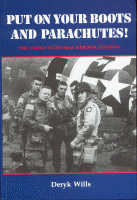
title for the book about the 82nd Airborne Division of the US Army is
taken from the unit�s song �The All American
Soldier:� The
song starts out with the words �Put on your boots, boots, boots /
And parachute- chutes- chutes / We�re going up, up, up / And coming
down, down, down / We�re All American and proud to be for
we�re the
soldiers of liberty.�
Prior
to D-Day, elements of this Division were stationed in the East
Midlands including Northamptonshire
and Nottinghamshire; however, most of the 82nd Airborne was stationed
in and around Leicester and in the county of Leicestershire. For example: Braunstone Park
was the site of the Division Headquarters camp; the 325th Glider
Infantry Regiment was stationed on Beeby Road in Scraptoft; the 309th
Glider Artillery Regiment were billeted at Papillon Hall, Lubbenham,
near Market Harborough; the 504th Parachute Infantry Regiment was
stationed on Shady Lane, Evington; the 505th Parachute Infantry
Regiment was stationed on Wood Lane in Quorn. It is the story of the
latter regiment - the one stationed in Quorn, the most renowned and battle-hardened regiment
from the 82nd - that forms the focus of Deryk�s book:
Put
On Your Boots And Your Parachutes
�
Quorn
& Leicestershire
Copyright@Deryk
Wills
In
the first few months of 1944 the American Paratrooper became a
familiar figure in Leicestershire. He was the elite of the U.S. Armed
Forces, the pride of General Eisenhower, being easily recognised by
his unique calf length jump boots and sporting the hard won silver
parachute badge on his breast. He knew he was among the best.
The
82nd Airborne Division arrived in Leicestershire from Italy on the
14th February. One of its Regiments was the famous 505th Parachute
Infantry Regiment who were camped in Wood Lane, Quorn, known to them
as Tent City.
Since
leaving the States the 505'ers had excelled themselves in Sicily and
Italy fighting and defeating some of Hitler�s best troops, such as the
Hermann Goering Panzer Division. After two successful combat jumps
their confidence showed that they were ready for anything.
Their
arrival in the green rolling countryside of Leicestershire was a
welcome break from the rigours of the Mediterranean. Where they had
come from there were no liquor stores around, and when available a
bottle of scotch could cost $40. Cone were the North African sand
storms that always seemed to arrive at chow time. There was no way to
separate the sand and flies from the food. Another unpleasant
experience left behind were the problems of dysentery and the
overloaded latrines.
Jim
Coyle remembers his first impressions of Quorn: �Our new base
consisted of pyramidal tents pitched in a park at the edge of Sherwood
Forest of Robin Hood fame, between Leicester and Nottingham.�
(Editor�s note: Those are
Jim's words. In fact, Sherwood Forest is
about twenty-five miles away to the north).
�A
liberal pass policy was initiated and except when night training
problems were scheduled, groups of men on a rotation basis were
allowed to go to nearby towns almost every night.�
The
men of the Division made friends very easily and the Leicestershire
people took them to their hearts. Lifelong friendships were formed and
Quorn is always remembered at their reunions. Still talked about, and
relished, 50 years on, are the fish and chip suppers wrapped in
newspaper that could be bought from Atkins, the village �chippie�
Their favourite pubs were the White Horse Inn in the centre of the
village and the Bull�s Head where they drank their �mild and
bitter�
beer; and still do today whenever they make their frequent visits to
England.
Sergeant
Charles Kaiser and his friend, Ray Cridland, used to favour the Bulls
Head pub. �It wasn�t so rowdy as the others. We learnt to play
darts and drink their warm beer. Two old maids ran the pub, and one
night Ray told them that the Americans liked their beer cold. From
that night there were supplies of iced beer for us, and the locals
started asking for it too.� John
Levitsky of 1 Company made sure he always walked slowly out of an
English pub because the fresh air, after drinking �mild and
bitters,�
could knock you out even if you were built like a weightlifter.
At
the weekends they made sorties into Leicester to have a drink in the
city pubs and to dance at the Palais de Dance in Humberstone Gate. The
Grand Hotel was exclusively for officers, or so they thought. One
Paratrooper found a way to gatecrash that select club. Private Ken
Ceis of 1 Company used to meet his art student girlfriend, Margaret,
at her house. She had a brother away at the war so Ken used to change
into one of the civilian suits hanging in the wardrobe. Aided by some
GI gasolene, thoughtfully brought in a jerry can, the car in Margaret�s garage was sprung into life and provided transport to the
Grand. Much to Ken�s surprise and delight the car was a luxury Rolls
Royce.
The
officers never suspected that a Gl Joe was in their midst. Forty two
years later Ken told the story with some glee. Just
before D-Day Ken and Margaret got engaged and she was given his
coveted jump wings. As he recalled the happiness didn�t last long,
Margaret sent him a �Dear
John� letter which he received in Normandy.
�Oh how I loved that girl,� he told me wistfully.
I was able
to tell him that Margaret still treasures those jump wings to this
day.
On
their nightly tours of the Leicester pubs, drinking as much as they
could, there was usually trouble. If a guy fell down drunk then his
friends would take him outside and prop him up by the side of the
road. The trucks going back and forth to the camp would then stop and
throw him in the back. If
the MP�s had to step in they would do the honours for transport. Next
day you would be in front of Colonel Vandervoort who would chew your
ears off, but that would be the end of it.
Robert
Veria of Headquarters Company remembers the White Swan Hotel in
Leicester�s Market Place. The bar was on the second floor above some
shops. One night several 505 men were drinking there when one shouted
out, �Stand up and hook up!� Then standing on the scat by
the open window gave the order, �Lets go!� With that he
jumped to the pavement, about fifteen feet below, followed by the rest
of the party.
The
Barmaid took sometime to get over the shock of seeing her customers
disappear out of the window so high up. From then on it became a
regular feature of the evening�s entertainment. On Sunday nights the
Salvation Army Band use to play in the Market Square nearby. The
drummer was always ready to give a special roll on the drums as the
Paratroopers did their graceful exit and fell to the ground.
The
82nd Airborne Division were not the first Americans to be based in
Leicester, already there were an all-black U.S. Transport Battalion.
The Paratroopers were mainly from the Southern States, so right from
the start there was trouble. On the night of the 28th February war
broke out on the streets of the city. The warriors had found the
Blacks in command of the city and the girls. There were dozens of
fights and well over twelve servicemen suffered knife wounds. The
interior of the American Red Cross Club, opposite the Y.M.C.A. on
Granby Street, was wrecked.
It
was a rule that only a limited number of men received passes every
night to leave the camp. On that night in question a number of 505 men
were injured in the fighting. The Regimental Commanding Officer at
that time was Lt. Colonel Herbert Batcheller whose home town was in
the Southern State of North Carolina. As the men were forming up for
lunch the next day he personally announced that, �Everyone is on
a pass tonight!� His intentions were obvious. That
night every available paratrooper came to Leicester looking for
revenge.
General
Matthew Ridgway toured the city for several nights in his jeep to calm
his boys down, and he was the only man who could do it. He doubled the
MP�s on the streets and the Black unit was quickly transferred to
Kettering, some 28 miles away. There
it was reported that they broke into an armoury to obtain weapons to
get their revenge on the Airborne. Roadblocks on the A6 were set up
and the situation quietened down.
Not
one word of this got into the local newspapers as it was a military
secret that the United States 82nd Airborne Division was here in
England. Searching through the official records of the day there is
only one mention of the troubles. In the Minutes of the Police
Committee No. 12, held in the County Rooms on 24th June 1944, it is
recorded that, �Nineteen members of the U.S.A. Forces were dealt
with by their own Courts Inquiry.�
Ridgway
ordered an inquiry and on the 21st March, Lt. Colonel Batcheller was
relieved of his command and transferred to the 508th Parachute
Infantry Regiment who had just arrived in Nottingham. This was not the
first time that Batcheller had committed an indiscretion but was given
a chance to redeem himself with the command of the SOS�s First
Battalion. The
new C.O. of the 505th Parachute Infantry Regiment was Colonel William
E. Ekman who commanded until the end of the war.
Herbert
Batcheller was killed in action on D-Day. It was later claimed by
General Ridgway that no one had been murdered in the troubles,
contrary to many rumours. Recent information from Jack Sneiderman,
together with the knowledge that a body of a Military Policeman,
Corporal Arthur A. Abrams, is buried at American Military Cemetery at
Madingley, Cambridge, gave serious doubt to that statement. On
research it has been found that the violent deaths of two American
servicemen occurred nine weeks later outside a public house, the Dixie
Arms, in Humberstone Gate only a few yards from the Clock Tower.
The
answer was found in the Last News Edition of the Leicester Mercury,
dated 3rd May 1944. There is a front page news report which states:
U. S.
ARMY POLICEMAN KILLED IN LEICESTER
A
Military Policeman was one of the two American soldiers who received
fatal injuries in Leicester on Monday (Ist May). One of the victims
died from a knife wound in the neck, the other is stated to have died
from self-inflicted wounds.
The
affair occurred round about closing time outside a public house in a
main street near the centre of the city. The
American military policeman received fatal injuries when trying to
create order. The two men were dead when they were taken to the Leicester Royal
Infirmary. Others received minor injuries.
All
the investigations are being made by the American military
authorities, who state that the matter was purely a military one, and
had nothing to do with the civilian population. In
the circumstances no inquiry will be held by the Leicester City
Coroner.
The
date of the death of Corporal Abrams is listed in the records as lst
May, 1944. No other 82nd Airborne trooper is listed as having died
that day, so it is possible his assailant, the other American,
belonged to a different unit. In
the last few days of February, as usual for the time of year, snow
fell and the camp sites were carpeted in white. The main problem for
the boys was to keep warm and dry. Later the English spring blossomed
forth and life took on a brighter hue.
There
were several Divisional dances held in the city, at the Palais de
Dance for the men, and at the Grand Hotel for the officers. The 82nd
Airborne Orchestra supplied the music. It appears they had a private
running joke with General james Cavin because when he entered the Hall
the orchestra would stop and break into a jazzed up version of �Maresy
Dotes and Dosey Dotes.� The 82nd Divisional Band gave a concert in the
Town Hall Square and the locally based ATS girls joined with the
paratroopers to produce the musical comedy, �Together We
Sing.�
Surrounding
Tent City was a high stone wall. As Tom MeClean of D Company said
later, �if you had a pass you went out the front gate. If you
didn't have a pass you went over the wall, and if you came back late
you came over the wall.� Part of that wall is still there today. Climbing
over that six foot stone wall was the only way of missing the guard on
the front gate. Scaling the section of the wall nearest to D Company's
tents meant crossing a piece of private land belonging to Quorn House.
This was, unfortunately, the home of a very large bull mastif dog. He
had a head as large as a lion and didn't take kindly to trespassers.
The dog's name was Wallace, named after one of the Kings of Scotland.
The wary latecomer's technique was to make a quick sprint across the
open ground with this huge dog snapping at their ankles. In the end it
became a game of which trooper could beat the dog to the wall.
One
trooper remarked that when you heard that dog bark you quickly
realised that it came from �no little dog.� Once
over the wall into the camp it was a race to get into bed before the
Orderly Officer came round to check that everybody was in. Lieutenant
Tom McClean would come down the lines with his flashlight which meant
there was little time to spare. Frank
Bilich would quickly take off his jacket and jump into his bed,
pulling up the blankets and turning his face to the tent wall. Tom
MeClean said many years later, �You guys thought you were clever.
Do you know I could see the outline of your jumpboots under the
blankets. I knew who was in late.�
D
Company's mascot was a little sausage dog by the name of Herbert.
Nobody seemed to own him, but everybody fed him on scraps. He met his
fate in the jaws of the bull mastif, Wallace, and he was killed. Not
only did Wallace terrorise the Gl's, he also terrorised the villagers
of Quorn. The local village policeman, Police Constable Bobby Norman,
threatened to shoot the bugger on more than one occasion.
There
is one lady, Dorothy Waddingham who worked at Quorn House, who claims
that Wallace was not as fierce as he looked. She said, �He was
always my friend as I prepared his food. I can see him now, the way he
used to chase any wary visitors.� Dorothy's
parents had a house which backed on to the camp and she well remembers
the quick trips the lads used to make over the wall and down their
garden path to the Mill House pub across the road.
One
of the attractions of Quorn House was a Land Army girl by the name of
Edith. She helped in the vegetable garden. It is reported that she had
many 505 suitors. The
stable block had a cobbled yard which had been concreted over and used
as an outdoor dance floor for weekly socials. The staff of Quorn House
made a number of lasting friendships with the Gl's, and many of them
wrote letters to their families back in the States.
Carl
Clawson of B Company has many fond memories of Quorn. �The
generous manner in which the populace accepted an overwhelmingly large
contingent of young, sometimes very raucous soldiers, has always put
Quorn in a unique place in the minds of all of us fortunate enough to
have had the experience.�
�I
recall the Bulls Head Inn and the regulars who were kind enough to
permit our joining in their dart and cribbage games. The wartime
allocation of ale was in effect - but the supply was shared without
hesitation. Quorn enjoyed magnificent weather during your Spring and
the area was so beautiful. I recall almost enjoying the arduous forced
march programme inherent in our training.�
Carl
and his wife Betty visited Quorn in 1962 and as he was looking over
the old camp site was observed by the people living close by, and they
promptly invited them in for tea. �We had a great time and
corresponded with the family for sometime after.�
Another
local pub was the Pig and Whistle in Station Road. The para- troopers
had a problem in understanding the Licensing Laws in England. If they
had a supply of beer then they would open at 6pm and close at 10.
Frank Bilich remembers the publican at the Pig and Whistle would shout
at 10pm, �Time Ladies and Gentlemen please, and that goes for you
bloody Yanks too!� Nobody would argue with him, they would do as
they were told. One thing the 505 boys never got used to was the warm
beer. Frank called it then as he does now - �Horse Piss.�
�We
enjoyed the social life of the pub,� said Frank. �The
sing-songs with everybody joining in. There were no English men
around, they were all in the services. The pubs were full of girls,
ATS girls (Auxillary Territorial Service, later to become the Women's
Royal Army Corp) from the camp at Woodhouse Eves, Land Army girls and
WAAFS from the airfields. It was just like being in heaven.�
�One
thing I remember about the English is that nobody bitched about
anything, and they had it tough with their rationing. The same with
the British Army, they used to say �What's the hurry Yank, the war
will still be there tomorrow.�� Tony
DeFoggi came as a replacement to join the 505 after their return from
Italy. He relates his adventures on arriving in Europe and joining his
new regiment in Leicestershire.
�You
probably did not know this, for it was the best kept secret of the
war. Why? Because I was so sea-sick coming across the Atlantic Ocean I
did not care if ever I fought the war or not.� �We
landed in Northern Ireland and our first camp was just outside
Newtonards which we immediately named Camp Starvation. I was told by
the guys that if you get put on KP's then steal some food. Of course,
being a new arrival I was soon put on that duty. When I left the mess
hall that night they were missing a whole ham. The men in our Q-Hut
thought I was a hero.�
�Next
day I received a pass and went into town. There I was minding my own
business and admiring the view when an old Irish lady called out, �Yank, you are in trouble. The MP's are coming. Get into the
house.� I
did as she told me.�
�A
record player was playing �I'm dreaming of a White
Christmas� by Bing
Crosby. There was a knock on the door. �Go hide under the
bed,� she
said. I did. I could not hear what was being said, but here I was
hiding under a strange women's bed listening to Crosby. My Mother
would never believe this; she knows I am not even a fan of this Crosby
guy, I dislike him. Like me she's a Sinatra fan.�
�It
was after dark when I arrived back at camp and there I was told, to
pack up as we were being transferred.� �The
ferry landed us at Stranraer in Scotland and we stayed in a camp for a
week. Here there was plenty of food and we ate well. I also met a nice
young lady in a blue uniform. I think she was a W.A.A.F. (The British
Womens Auxiliary Air Force).�
�From
Scotland we travelled to Leicester and then on to Camp Quorn. I was
assigned to F Company and reported to Sergeant Leo 'Hoss' Pizarro (he
called everybody Hoss). He picked up my bag and told me to follow him.
I thought this was great, a Sergeant carrying my bag. We stopped at a
tent and he said, �This will be your home while we are
here.� Boy, was
I disappointed - a tent with full blown air conditioning from
everywhere. But we got to love it after we came back from
Normandy.�
�They
put us through some hard training and we made a few jumps. Every night
after dinner we went into town. If you had a pass you would go through
the gate, if you did not, you jumped over the wall.� �Meanwhile
I met this young lass and we would walk around the Square, looked into
the Pubs and watched the older Yanks make fools of themselves (now I do it). One evening
I noticed this Cop was following us. �Sheila, I think that policeman is following
us!� �Pay no attention, he is my
father,� was the reply.�
�At
curfew time we caught the truck back to camp. It made two stops, one
by the wall and the other at the gate. That night I got off by the
wall for I had no pass. When I arrived at my tent the Platoon Sergeant
Bonnie Wright (he died of wounds in the Ardennes) told me to report to
the Command Post.� �At
the C.P. there were men lined up waiting to see what was going on....and we shortly found out. When I got in there I was asked where I was
when there was a call for Formation. Everybody else made an excuse
that they were in the showers or something but I told the truth and
said I was in town. The First Sergeant, John Field, nearly fell off
his chair and he ordered �Report to your quarters and don't
leave.��
�Dark
and early the next morning I was told to dress in full battle gear
with a complete full-field pack and go to the Supply Room and draw a
day's rations. The day was Easter Sunday. Because I told the truth the
Company Commander, Captain Hubert Bass; the First Sergeant, jack
Field; the Platoon Leader, Lieutenant joseph �Little
Joe� Holcomb; the
Platoon Sergeant, Bonnie Wright; my Squad Leader, Leo �Hoss� Pizarro
and the Assistant Squad Leader, George Ziemski all had to make the
day's march. It became known as the Easter Parade.�
�At
the noon-break I was sitting under a tree all by myself when Hoss came
by with a bunch of K-Ration boxes. He wasn't very happy, �Here eat,
for this is your Easter Dinner,� he said sarcastically. I felt very
small. Right there, sitting under that tree, I promised I would never
tell the truth again. When we got back to camp nothing was said about
the march, and I made sure that I never went on one again.�
�We
kept on training hard. Then on that fateful Monday we were herded to
the airfields. A week later the 5th June jump was cancelled. Ike gave
the green �Go� for the 6th and then he wisely went to bed with his
driver, Kay Summersby. � �It
was my Platoon Leader, First Lieutenant Joseph �Little
Joe� Holcomb,
who, on 19th September 1944, dragged me off a Nijmegen street to
safety when I got hit. He must have forgiven me for the Easter Parade.
I have not seen him since and I have tried for years to locate him...
I owe him something, he saved my life.�
The
Easter Parade was the result of Colonel William Ekman's arrival to
take over the command of the 505. He decided that the discipline was
getting a little slack and the men were leaving the camp without
passes at night. On
the evening of Easter Saturday, 25th March, he ordered a �Charge
Call�
to be blown at 8 p.m. Every able-bodied Trooper in the camp had to stand
in formation for a role to be taken. Anyone missing and not on an
official pass was declared AWOL. The next day the absentees, together
with their officers and NCO's, went on an all day hike as a
punishment.
Charles
Kaiser reports that Princess Elizabeth, then in the ATS, came on a
visit to Quorn and was invited to sit in the reviewing stand as the
505 paraded. The men could not believe that �a real live
Princess� was
in their midst. This researcher has been unable to find any facts
about this visit, but somehow this event is firmly fixed in several
veteran's memories. Somehow and somewhere that pretty twenty year old
Princess captured many a paratrooper's heart and it is known that some
jumped into Normandy with her picture in their pockets.
The
Regiment did receive other official visits, there were several from
the local Police Constables in search of �missing� bicycles from the
village. Some official representatives also came to note that several
trees had disappeared from the camp site and used for firewood. The
village baker, Erie �Dud� Tornlyn, was kept busy in his bakehouse
which backed on to the Churchyard. The 505 cooks found the ingredients
and 'Dud' worked overtime baking the fruit cakes, which were made in
large three by four foot tins, and the two foot long milk loaves.
All
this was watched by his young daughter, Dorothy, who marvelled as
thousands of doughnuts were produced. These were transported to the
camp in a back of a jeep threaded on long canes. One trooper's name
has stayed in her memory all these years as it rhymed with a famous
bandleader of the day - Harry James. He was Sergeant Larry James, the
'Mister Fix-it' from the Headquarters Company who organised all the
ingredients. Once �Dud� said he was short of cooking oil and Larry arrived soon after
with a fifty gallon drum of it. Dorothy's father puzzled for days over
the correct amounts to use. She remembers the family ate bright yellow
cake for a week until he got it right.
Dorothy,
or �Billie� as she is known in the family, had a constant supply of
chewing gum which caused so many sticky problems in the village
school. Eventually it was banned and the children were punished with
the cane on being caught with it. Dorothy remembers suffering that
fate. Those
few months for the Tomlyn family, when the paratroopers were their
neighbours, were the brightest of the war years.
A
newspaper boy, thirteen years old Tony Gale of Quorn used to deliver
for joyce's newsagents around the village. Forty seven years later the
happy memories came flooding back. Tony recalls the evening when he
first met the 505'ers settling into their camp. The Americans seemed
to be very organised. He
used to sell many copies of the Daily Mirror at the camp gates. During
the day, he and his friends used to prop their bicycles against the
wall and stand on the cross bars to look over into the camp. They used
to watch the men boxing with big red gloves in a boxing ring.
The
paratroopers used Tony as their messenger boy and sent him for fish
and chips from Atkins Fish Shop on the main road. The young boy used
to climb over the wall to deliver them to his favoured tent. �The
tent used to be full of smoke, no filter tips in those days, and there
was usually a game of cards going on or some dice rolling,�
reminisced Tony. �The village was always full of friendly
GI's
wearing their famous jump boots and I can remember them sitting on the
low wall outside the Pig and Whistle drinking the warm beer, just as
if it was yesterday.�
It
was an open house where Mrs Elizabeth �Bess� Sutton lived in the
nearby village of Barrow-on-Soar. She had an old farm house at 12
Church Street. The boys used to gather in her parlour to warm
themselves on the cold evenings. She remembers Henry Voges from Texas,
and she did correspond with his mother until after the war. Another
was Fred Schrefier who was saving to get married to an English girl,
Lilly Hills, who worked at Quorn House. He gave his money to Bess for
safe keeping and she hid it under the linoleum floor covering in her
bedroom.
The
wedding never took place as the romance failed. Fred had his money
back before the 505 left to fight again. Bess Sutton always knew when
combat was in the air. �The boys used to have very close haircuts
and get very quiet, I knew when they were getting ready for something.
They used to bring me all sorts of food. I did worry where they got it
from but they assured me they hadn't done anything wrong to get
it.�
One
of the mysteries of the camp at Quorn was the identity of the �Green
Hornet of Quorn.� It appears that on dark nights several of the HQ
Company troopers returning from the pubs felt a tap on the shoulder,
and on turn7ing around received a heavy punch in the face, usually
resulting in a black eye. The assailant was always described as a
little guy who immediately ran away towards the Second Battalion area,
through D Company lines heading for E or F Companies. To catch the
Green Hornet they assigned Joe �Tiny� Horvath of the HQ Company,
described as 6 foot 4 inch giant, with arms hanging down like a
gorfila, to act as a decoy. He patrolled the area on several nights,
acting as though he was drunk. He never was attacked.
The
prime suspect was a tough little New Yorker of F Company who was a
men-tber of the Regimental Boxing Team, �Teddy� Tedeschi, weighing in
at 118 Ibs. Pfc.
Richard �Teddy� Tedeschi, aged 22 and 5 foot 4 inches in his socks
stretched himself as much as he could on his medical to reach the
required 5 foot 5 inch minimum. He is stffi accused of being the
culprit forty-seven years later, and still denies it. Although he did
say recently �I used to drink with Tiny in a pub - that's why
I never hit him.�
The �Green Hornet� was the talk of the camp and everything that happened
was blamed on him. One night they heard some shots being fired,
�Now he is shooting us,� somebody cried.
�Teddy�
Tedeschi enlisted in the army on Ist March 1942, in New York City and
standing next in line was Andy Kilcullen. Their serial numbers were
consecutive. There a 'father and son' relationship was formed which
lasted forty-five years. Both did basic training together, joined the
505, with Andy in B Company.
Tedeschi
is still parachuting and organises the Old Tymers Parachute Club which
jump at the annual reunions. In 1987, at the age of 67, he parachuted
into the grounds of the Dutch Liberation Museum at Groesbeek as a
prelude to its opening by Prince Bernhard of the Netherlands. The
strong wind carried the light-weight Tedeschi away from his intended
target and he finished up in a tree in the Old Mill Hotel next door.
He was rescued by the Dutch military and pictures of the episode
appeared in all the Dutch newspapers. His excuse was that he felt like
a
beer and landed as close as he could to the bar.
Another
of the Regiment's boxers was Cari Beck, a huge genial man and a
College footballer. He was a good soldier both in combat and in
garrison, but he wasn't perfect. He milked his position on the
Regimental Boxing Team for all it was worth by claiming he needed time
for boxing training instead of going out with the troops in the field.
To be fair, any good soldier would take advantage of any angle to beat
the system, and Carl did win the Division's light-heavyweight
Championship.
Carl
had a friend who, though a good man in combat, was considered a �heartache� because of his tendency to get in trouble. Beck's friend
failed to show up after a three-day pass, and Carl with the best
intentions - or so he claimed - got a pass and went looking for his
friend. Carl too went missing and when he returned was charged with
going AWOL. Beck
was up for a Summary Courts Martial, but the Company Commander agreed
to waive this if he would accept Company punishment under the 104th
Article of War. When his Lieutenant, Jim Coyle, informed him of this,
Carl asked him his advice. Coyle told him to accept the punishment,
which he did.
Coyle
knew that Cari's Private First Class rating was at stake, and so it
was, and the memory of that lost stripe has stayed with Cari all these
years. Jim
Coyle has never been allowed to forget it. As Jim says, �For
forty-seven years at reunions, Carl has reminded me that my advice
cost him his Private First Class stripe. He claims that I failed him
as his Defence Council (a position I might have held only if I were
assigned at a Courts Martial). My explanations are of no avail. At the
last E Company Reunion, Tony DeMayo went to the local army supply
store and bought a set of Pfc. stripes.�
When
Carl was called upon to say a few words, he included an account of the
loss of his Pfc. stripes. Tony went up to the podium and made a formal
presentation of the Pfc. stripes to Carl, who laughed along with the
rest of us. However, I am not sure that I have heard the last of Carl
Beck's lost Pfc. stripes. As
you can imagine these young paratroopers were a pretty wild bunch. Don
McKeage recalls that it seemed that every time someone got into
trouble, somebody recognised him as a �Mac,� or someone would hear a
shout of �Hey Mac!� It was a regular thing for every
�Mac,�
or �Mc� in the Regiment to be ordered to report to the Regimental
Headquarters in Class A uniform for an identity parade.
�A
couple of times I recall this happening, once when some trooper beat
the living hell out of a local girl, his buddy finally hollered �Hey Mac, lets get the hell out of here!� Another time when
Major Edward C �Cannonball� Krause was leaving the Officers Club,
someone knocked him down with a big club. �Cannonball� regained his
feet, jumped over the stone wall that surrounded Camp Quorn and chased
his assailant into the woods. He lost him but he thought he recognised
him as a �Mac.�� It
was Captain Robert Kirkwood of the Third Battalion who gave Krause the
nickname of �Cannonball� when writing up the Field Orders for
Normandy. He was looking for a suitable code name to be used in
battle. From then on the Third Battalion adopted the insigna of a
cannonball and it was painted on their helmets.
The
505 trained in the areas of Charnwood Forest and the Sherwood Forest
of Robin Hood fame. The local country lanes saw them on their training
hikes. In the old county of Rutiand a parachute school was established
on the airfield at Ashwell. Everyone was getting ready for the big
day, but when that would be they could only guess. The
first hour of the training schedule each day was thirty minutes of calisthenics
followed by a thirty minute run. While no one took
pleasure in this activity at 7am in the morning, they were all in good
physical condition and the only ones who had a slight problem with the
exercise were the men who had been on pass the night before and had a
little too much to drink.
E
Company was typical, but Lieutenant Jim Coyle noticed that one of his
men, Private Joe Yoni, would occasionally fall out of the column
during the run. Jim questioned him about the problem but Joe denied
that he was suffering a hangover, he would just say he could not go
on. One
night Jim Coyle went to the Palais de Dance in Leicester and there to
his amazement found Private joe Yoni was the main attraction for the
English girls. He was an excellent dancer, particularly adept at the �Lindy�
or as the English called it, the �Jitterbug.�
He never lacked a
partner and danced non-stop for hours.
The
officer began to get the picture, and the next morning when joe Yoni
fell out of the column during the run he shouted back at him that he
had been seen in action the night before at the Palais de Dance. Now
if he didn't finish the run he had danced his last Jitterbug as there
would be no more passes to Leicester. The
threat struck home, the English girls and the Jitterbug won. Yoni
sprinted to catch up with the rest of the men who were laughing so
hard that they nearly fell out. Private Joe Yoni never, fell out of a
run after that, even after a hard night at the Palais.
Several
mass training jumps took place. On Saturday, 6th May, there are
reports of hundreds of parachutes coming down over the east side of
Leicester in the Scraptoft and Tilton area. Eager troopers quickly
rolled up their chutes and ran towards their allotted rendezvous. Jim
Coyle's main concern was training his Platoon for the next combat
jump. �Around Quorn there were plenty of open fields in which to
manoeuvre, so training problems were conducted on a daily, or a
nightly, basis. On the third manoeuvre which was to include a jump,
the planes became disoriented due to bad weather and E Company flew
around for several hours before finally landing at, what I believe
was, an RAF fighter base. I don't know where it was located but it was
a long ride back to camp in trucks.�
�Due
to this incident and my experience in North Africa and the Sicily
jump, I was becoming quite concerned with the Troop Carrier
navigation. However, a Pathfinder group was formed with the best
pilots and navigators to drop paratroopers with small radar sets ahead
of the main body of jumpers. They would send signals from the Drop
Zone that could be picked up by the approaching planes.� �When
they heard the lead planes approaching they would be able to turn on
lights which would identify the Drop Zone to the pilot and the jump-
master in the plane. This gave us a little more confidence in the
success of our next mission.� Allen
Langdon had memories of one practice jump. �We were doing a
practice night jump somewhere near Bradgate Park and I was the
next-to-last man in the stick. We were jumping near high tension
cables but we were told that the electricity was turned off.�
�Sergeant
Wartick was the last man - he hit the cables but the electricity had
not been turned off. They shorted, the sky lit up, and we all thought
he was dead, but all he had done was burn his boots.� Corporal
Thomas Burke, a very brave soldier who was later killed in action in
Holland, was one of E Company's authentic characters. He
was very proud of a full-page picture from Life Magazine portraying
him kissing his girlfriend goodbye at Pennsylvania Station in New York
City. In the picture, an approving Military Policeman stood smiling
nearby. Burke carried the picture with him always and would show it to
every new replacement who joined E Company. The picture was something
of a joke amongst the veterans of the Company, because one of them
remembered that Burke was AWOL at the time the picture was taken.
One
of Burke's favourite stunts, after a few pints in the English pubs,
was to break into a loud song. Unfortunately, Burke's entire
repertoire consisted of IRA revolutionary songs, but his act was much
appreciated by the English people. One
of Lieutenant Jim Coyle's favourite stories about Burke did not
concern combat, but it gave Coyle a pretty harrowing time. It occurred
at the famous - or infamous - E Company party in Barrow-on-Soar, which
is a village adjacent to Quorn.
Coyle
relates. �After the party had been underway for about two hours,
I had my hands full trying to maintain a semblance of non-violence. In
the midst of the action I was called to the door of the rustic
pavilion in which the party was being held, to be greeted by a very
big and very irate Military Police Lieutenant. He had been on patrol
in the village. He informed me that his Jeep had been stolen and since
the E Company party was the only game in town, he was certain that one
of my men was guilty.� �He
was giving me a hard time and it crossed my mind to ask him where he
was and what he was doing when his Jeep was stolen. However, in view
of his justifiable anger, I realised that this would not contribute
anything helpful to our conversation. I assured him that none of my
red-blooded American boys would steal his Jeep, and after some
discussion he and his Sergeant left.�
�With �Double British Summer
Time� it was still daylight, and I watched the
MP�s go out of sight around a corner up the road. At almost the same
time I saw a Jeep come weaving up the road from the opposite direction
with Burke at the wheel and a large barrel of beer in the back!� �With
the thought of saving the party and E Company's fairly unblemished reputation,
I reacted quickly: I got Burke out of the Jeep, had a
couple of men take the beer into the pavilion, told a young soldier,
who appeared to be one of the fairly sober men present, to drive the
Jeep several blocks away, park it on a side street somewhere where the
MP Lieutenant would find it, and return immediately to me.�
�The
young soldier was barely out of sight when I realized that in my haste
to get rid of the Jeep in the event of the MP Lieutenant should
return, I had not had sufficient time to consider all the angles to
this problem. It suddenly struck me that if the MP Lieutenant spotted
the Jeep with my man still in it Burke would have a fellow defendant
at his Courts Martial - Me! The young man who drove it away was acting
on my order.� �The
next ten minutes seemed like hours as I waited in the road for the
return of the young soldier, praying he would not be accompanied by
MP's. When he returned alone, I breathed a sigh of relief and returned
to my duties inside. The party was wild as ever, but I was at
peace.�
Raymond
Rodriguez and Joseph Przybyla both went through Jump School together
in the States, but somehow they finished up in England in the 30th
Infantry. They tried to get back to the Airborne without success until
one day their Captain spoke to General Eisenhower. �That's the
kind of men we want!� exclaimed Ike, and the very next day a
truck from the 82nd picked them up. They both served in 1 Company,
505. Private Joseph Przybyla was killed in action in Normandy.
D
Company, Frank Bilich claims, were �goofy� in garrison, but excellent
soldiers in the line. �They were the best guys in the world to be
in a tough spot with. We had some crazy guys, I remember two of them.
One, Pfc. William �Swamp Rat' Skinner was
over six foot tall, and he
was matched up with Pfc. Dominick �Dippy� Deppolito, who was only five
foot five, as a machine-gun team. Skinner always let Dippy carry the
machine-gun because he said Dippy liked it that way. Skinner, the
large guy carried the tripod.�
Later,
Deppolito was to win the Silver Star for bravery in Holland.
�There was Pfc. Frank �Trigger� Schneider who was blind as a bat
without his glasses, and he was the Company runner. I suppose if
anyone could find his way in the dark it was him. He once fell down a
hole. He did get shot in the arse but he always claimed it was �high
in the thigh.� He started the war with four pairs of glasses and broke
his last pair in the Holland jump. The Dutch found him another
suitable pair so he could carry on with his war.�
�The
worst words Sergeant Stanley �Saddlebags� Kotlarz heard after he fired
his machine-gun at a suspect image was, �Guess what Sergeant, you've
shot one of your own officers in the ass.� The officer concerned was
Lieutenant Isaac Micheiman. Sergeant
Milton Schesener had a built in radar system. He never got lost. He
was a good soldier and an excellent shot. In Holland he had his
picture taken by a Dutchman which was subsequently used in several
Dutch publications and later in the museum at Groesbeek.�
�One
guy who never swore was Bryant Jones, even when he was hit. A piece of
shrapnel took his thumb and a finger off as clean as a whistle. �Well
I'll be, look at that,� was all he said.
There
was an American Indian by the name of Herbert Buffalo Boy Canoe from
the Oglaia Sioux tribe who finished up with the Silver Star, a Bronze
Star, plus two Purple Hearts. I believe he was the most decorated
Indian during the war. If you saw him sober he would scare the hell
out of you. We had a little skinny guy, Roy Stark, he was the only one
who could handle him.�
�One
guy who was always terribly sick in an aircraft was Paul �Little
Nellie� Nelson. He used to lay on the floor in pain, but he made the
jump every time - never missed. He came from Playingfield, New Jersey,
and after the war he was found dead in the street. He was a vagrant, a
street bum, and he finished up in a pauper's grave.� The
wild men of D Company Frank Bilich remembers were M.P. Brown, John
Haggard, a guy called Robert Niland, Kenneth �Red
Dog� Auther, Frank �Barney� Silanskis, Charles
�Smiley� Manovich, Joseph
�Big Joe� Skolek
and Tommy Thompson.
�John
Haggard was a wild one. One time a piece of shrapnel went right
through his helmet and that never slowed him down. He was killed in
action in Normandy. Niland, �The
Beast� we used to call him, had an awful mouth full of teeth that
showed when he smiled, which was not often. Tommy
Thompson got into many fights in Leicester. One night he fought with
the MP's and knocked a Provo Marshal on his back.
I don't
remember why he was called M.P. Brown, maybe he only had initials to
his name, (Editor: from the records it was Melvin P.) but he was a
tough fist fighter who could take on four or five men at one time. He
had huge hands and built like a tank.�
�Brown was always in trouble. When he came out of a combat zone
you knew he would be off AWOL, and you could not do much about it. He
was the best combat soldier you ever saw, a sort of guy you would want
next to you in a tough spot.� John Rabig, his Staff
Sergeant, takes up the story: �M.P. Brown? That guy was a
play-boy in garrison, he wanted wine, women and song. He was going to
get that, what the hell the circumstances were. Brown was once again
in the camp stockade. A barbed wire enclosure with pup tents to sleep
in.�
�Brown
was due out of the stockade after serving five weeks for something or
other. One day I was sitting in the Orderly Room when the phone rang.
It was the MP's to tell me that Brown's time was up and he was due out
now. So I go down to the stockade and get the son-of-a-bitch.�
�As
we are walking back to the Company, he says, �Will I get a pass
tonight?� Now this is the guy I've just got out of the stockade and he
is asking me for a pass. My
answer was �No!�
�Why not?� Brown asks.
�Because
you are on Guard Duty tonight. You happen to be on the roster.�
Brown was not very happy. I
told him, �You go on Guard Duty tonight and I'll see you get a pass
for tomorrow,� He agreed. It was a combined Company guard, with about
six men from each Company forming the guard to police the camp.�
�So
Brown stood guard that night. I'm sitting in the Orderly Room later
and the phone rings. I
answered, �Company D, Sergeant
Rabig.� �Is
M.P. Brown in
your Company?� �Yes, he is on Guard Duty tonight.�
The voice on the other end of the phone says, �No he ain't, he's
in the Guard
House.� �Oh shit!� I just got him out of there and now he is
back in. So down I go to the Duty Officer and found out they put him
in charge of the prisoners at the stockade, his friends who he had
spent the last five weeks with. It appears that the prisoners were
supposed to be clearing up the garbage around the perimeter of the
camp. The Duty Officer had found Brown's rifle leaning up against the
wall, Brown was holding a baby while his two charges were with two
dames in the bushes.�
�The
Duty Officer throws all three in the Guard House. I go and see Brown
the next day. He says, �Well, they were my
friends.� What the hell can
you do with a guy like that?� Kelly
the Medic, alias Corporal James Kelly used to go into Leicester
regularly to get drunk. He sometimes managed to mess up his uniform
during this activity. One night he borrowed Staff Sergeant John
Rabig's jacket for a sortie into town. There he got into trouble with
the MP's for being drunk and was sent back to Quorn under escort.
Colonel
Vandervoort saw him and ordered Captain Taylor Smith to find out whose
jacket he was wearing. Captain
Smith came into the Company office, found Rabig there and said,
�Find out whose jacket Kelly was wearing tonight?��It's
mine,� admitted
Rabig. �God
damn it, you had better report to Vandervoort,� was the order.
Rabig went to the Battalion Office and found Vandervoort sitting at
his desk.
�I've come to see you about the jacket Kelly was wearing
tonight.� �Whose was it?� Vandervoort questioned. �It
was mine,� admitted
Rabig. �God
damn it. Get out of here.�
was the reply.
John
Rabig also tells how he became the First Sergeant of D Company,
�You got to remember that this was a civilian army, not like the
British with rigid discipline. Anyway the Company was short of a First
Sergeant and I, as a Staff Sergeant, had been acting as the
First. Colonel
Vandervoort gets the whole Company lined up and presents to them a
First Sergeant Turner who has just come over from the States. The
Colonel being very diplomatic says, �Anybody who wants Sergeant Turner
to be your First Sergeant raise your hands.� The whole Company in one
voice shouted, �Get that son-of-a-bitch out of
here.� They all knew
him. Vandervoort
then told Turner to return to F Company and gave the order, �Sergeant
Rabig, fall the Company out.��
From
then on Rabig was a First Sergeant. Sergeant Turner jumped into
Normandy but broke his leg on landing. For him the war was over and he
returned to the States soon afterwards. Rabig was never worried when
his men went AWOL. �They always came back when they were broke.
They maybe AWOL from camp, but when the rumours started that the 505
were moving out, they would come streaming back. Even the hospitals
used to empty. I remember one guy, Pfc. Frank Thierry, coming back
with his broken leg in a cast saying, �You bastards are not jumping
without me.��
Thierry
had broken his leg on a practice jump and was in hospital when'the
rumours were circulating that the 505 was pulling out. He went AWOL
and returned to D Company, had his plaster cut off and his ankle and
foot tightly taped. A bigger jump boot was obtained to enable him to
make the combat jump into Normandy. The
best story about being AWOL that John Rabig remembers is when the
Commanding Officer, Lawrence Price, asked him to take a look at a
telegram he had just received. It was from two troopers who were
adrift. It read, �Safe and sane, on a train, will be late, but
can explain.�
�What
the hell am I supposed to do with this?� Price asked. One man
Frank Bilich remembers with sorrow was Pfc. George J. Rajner who was
married with five children. He refused to buy his ten thousand dollar
Cl Insurance because he thought that his mother-in-law would benefit
if he was killed, and this fate he was expecting because of a
premonition. He tried to go seaborne for Normandy but was refused. His
premonition was correct, he was killed in action attacking Hill 131 in
Normandy. His last words, as he lay dying, were, �Make sure my
scarf gets back to Pennsylvania.�
Frank
often wonders how his young family fared. Many young hearts were
broken. A sixteen year old Loughborough girl, Dorothy Cumberland, met
nineteen year old Private David Berardi of A Company and they fell in
love. The meetings had to be in secret as Dorothy's parents did not
approve. Promises were made that David would return after the war to
claim her as his bride. Private
David Berardi was killed in action in the Ardennes battle on 6th
January 1945. Dorothy still visits his family in the States to this
day.
The
Mystery of Papillon Hall
Copyright@Deryk
Wills
The
men of the 319th Glider Artillery Regiment were billeted at Papillon
Hall at Lubenham, near Market Harborough, Leicestershire. Little
did they know that Lubenham and Papillon Hall has for centuries had
its stories of ghosts, murder and mystery. There is an account of how
the 17th century mistress of the Hall, Anna Marie Castell, on her
death bed at the age of 84, asked that her silken slippers should
always be kept there in case she wanted to go for a walk when she came
back. If the slippers were removed from the house she added, a
terrible curse would descend on the building.
This
Spanish lady had married Frenchman David Papillon in 1615. His
ancestors had come to England from Normandy with William the Conqueror
in 1066. For
many years her request was strictly adhered to, until someone decided
to remove the slippers for a joke. It is reported that straight away
two people in the house became ill and only recovered when the
slippers were returned.
In
1920 when the Hall was owned by Mr Frank Belville, the shoes were lent
to an exhibition in London. Immediately three people in the Hall died
and four of Mr Belville's polo ponies were struck by lightning. The
slippers were hastily recovered and to ensure they would never be
moved again, the key to the alcove door, where they were kept, was
thrown away with the shoes locked safely inside. When the 350 year old
Hall was rebuilt in 1922 the slippers were again moved, this time in a
glass case high up over a fireplace.
Associated
with her ghost-like memory there are reports of the 'four-in- hand
coach' being galloped along the main road from the Hall to Lubenham
village. White ghost-like apparitions in the area have been seen, the
last time in 1965. The
village folklore recalls that the 319th Glider Artillery Regiment of
the 82nd Airborne Division took over Papillon Hall in February 1944,
and again the curse struck. The story goes that a souvenir-hunting Cl
forced open the bottom of the case and took one of the slippers away
with him. Later the trooper met his fate by being killed in action and
the slipper was hastily returned. That is the story of the local
legend and it has been difficult to unravel the truth.
Joe
Clowry of the Headquarters Company of the 319th Glider Field
Artillery, now living in Lockport, NewYork, has recently told his
story to put the record straight. He writes: �We were billeted in
the main house of Papillon Hall, in one the many rooms containing as
many double bunks as could be squeezed into each room.
Before
settling in, we were lined up and given a briefing on how to behave in
England and especially warned not to become involved with a pair of
slippers that were encased and hung over the fireplace in one of the
main rooms.�
�Naturally
enough, as soon as we were dismissed, we all headed for the house to
search out the slippers. If I recall rightly, there was a large high-
ceilinged room to the right of the main entrance with a fireplace to
the left. Secured high up over the fireplace, near the ceiling was a
glass case contain- ing two slippers. They were hanging together with
the toes pointing down. As
best as I can recall the story that was circulated explained that the
slippers were worn by a young bride, in the distant past, at a Ball
held in the room in which the slippers were housed. Apparently she
died shortly thereafter and the slippers were enshrined in her
memory.�
�The
story gave us the impression that the house was haunted, but events
never revealed any ghost-Ue aberrations appearing during our
stay. It
was either after the first or second night we were there that on the
following morning we were all lined up again and advised that one of
the slippers was missing from the case. This disappearance was a
serious breach of etiquette that must be rectified by the return of
the slipper ... or else.�
�To
the best of my recollection, the slipper was back in the case within a
day or two and remained there for the rest of our stay. I am not
aware of how the slipper vanished or how it reappeared, nor who was
responsible for its disappearance, other than I believe an irreverent,
unthoughtful GI who stole down to the room by flashlight in the middle
of the night. His intention was to procure a souvenir. I also felt
that, because of the high location of the case, there was more than
one individual involved.�
�We
were at the Hall until late May when we left for Membury Airfield for
participation in Operation Overlord. We returned to Papillon Hall in
July and left again in September for Market Garden. We never returned
to Papillon Hall, and as far as I can remember, the slippers were
still in their proper place when we left.�
A
final piece of evidence has been supplied by another 319 veteran,
Edward R. Ryan of Hyde Park, New York. He says, �We knew that the
slippers were to bring bad luck to
whoever touched them. One of our fellows stole them and was in the
process of sending them home when he had a terrible accident with a
jeep. He returned the slippers quickly as the curse seemed to be still
working.�
�There
were stories of the �Duke�
who owned the place, he was an officer who
was stationed in the British Isles. He visited the Hall once during my
stay there. I understood he was heir to the Colman Mustard
fortune.�
The
�Duke� was in fact a Mr Rupert Belville who fought with General
Franco's forces in the Spanish Civil War. He was a major share-holder
in the Colman company and he died in 1952.
Another
legend was that the French Crown jewels had been hidden in the Hall
after the French Revolution. When the Hall was demolished in 1950, it
was carefully taken apart stone by stone without anything being found.
Today,
the only visible remains of Papillon Hall are the holes in the ground
where the cellars had been, but the legends go on. Folk tales are
impossible to kill. Both slippers now safely reside in a Leicester
museum.
Cottesmore
and Spanhoe
Copyright@Deryk
Wills
Early
on the morning of Monday, 29th May, the 505 paratroopers climbed
aboard trucks for the journey to two airfields to prepare for the
greatest invasion in the history of the world. At the end of May they loaded
their equipment onto
trucks and moved to an airfield. There they were told that they were restricted to
an assigned area, a row of pyramidal tents. The
field was patrolled by Military Police and they knew that this would not
be a practice jump this time.
The
two airfields were Cottesmore and Spanhoe. The Second and Third
Battalions of the 505 went to Cottesmore, situated in the old county
of Rutland and is still an active military airfield today. Spanhoe was
a temporary airfield three miles to the north of Corby,
Northamptonshire, and received the First Battalion and the Regimental
Headquarters. The two airfields were about ten miles apart. Also
included were units from the 307th Engineers and the 456th Parachute
Battalion of Field Artillery.
The
505 were hardened veterans, the premier assault troops of the United
States forces. They realised a long time ago that they were counted as
expendable. They knew that to survive they had to hit first and hit
hard. Generals
Ridgway and Cavin were hard taskmasters and this was the way they
trained the men. In their briefings they pulled no punches. Ridgway
told the men, �Some of you will die, this participation in world
history may be just a thought that you can take with you. You are
assured by me that you will be on the winning side.� Cavin put it
a little kinder when he said, �Some of us will lose our
way.�
They
had been waiting for Y-Day, or Ready Day, as it had been known for
months. That was the first day of June. Thereafter each day was
numbered plus 1, plus 2 etc. until the date was set for D-Day. At
Cottesmore seventy two C-47 aircraft were waiting, while at Spanhoe
forty eight C-47's were ready. At Spanhoe, 864 Paratroopers crowded
into a hangar for their sleeping accommodation. In all 2095 men of the
505 were standing by.
Both
airfields were sealed off from the outside world by the Military
Police. The only movement between them were the two Chaplains and
their escorts to hold the religious services. George �Chappie�
Wood
and the Catholic priest, Father Matt Connelly, both remember that the
attendance was better than usual. Both Chaplains promised to see them
in Normandy, as they would be jumping too.
�We
didn't have long to wait for our Normandy briefing for D-Day,�
said James Coyle, continuing his story. �E Company was to set up
roadblocks at Neuville-au-Plain, a small town a few miles north of
Ste-Mere-Eglise. Ste- Mere-Eglise was a main road junction which the
German reserves would have to use in order to attack the Fourth
Division which was landing on the beaches, east of our objectives. The
Third Battalion of the 505 was to take Ste- Mere-Eglise. The Second
Battalion, which included our Company, was to protect the town from
attack from the north by holding Neuville-au-Plain.�
�We
were briefed on our mission on large scale maps of the area and low
level aerial photographs of the town of Neuville-au-Plain. We were
advised on 3rd June to get a good night's sleep because we would be
taking off the next night to jump into France. The next day, however,
we woke up to heavy rain and strong winds.�
Craps
and poker games were in full swing to help pass the time. The stakes
were dollars and the recently issued French invasion money. Fortunes
were won and lost in the seven days they were cooped up waiting for
the word 'Go'. Private First Class 'Dutch' Schultz won and lost
$2,500, more money than he had ever seen at one time in all of his
twenty-one years.
With
a change in the weather it was late in the day when the word was
passed down that the invasion had been postponed for 24 hours. The
pre- planned dinner on the Sunday night had to go ahead. The
grim-humored comments were to the effect that �the condemned men ate a
hearty last meal.� The dinner was one of the best they could remember
since going overseas.
The
5th June 1944, dawned bright and clear. It was announced at reveille
that the invasion was definitely on for that night. By early afternoon
all was ready. Last minute briefings had been held, weapons checked
and cleaned once more, knives and bayonets sharpened. Many men,
because of the tension, could not sleep and they just stretched out in
their cots in the large aircraft hangar. Others took the chance to
write their last letters home.
Some
of the 505'ers chose to blacken their faces. Orders were to have their
hair cut to a half an inch in case of head wounds. Everyone was
checked to make sure that the two metal identity tags held by a thin
chain were around their necks. This was a long running joke amongst
the 505 as they Were always losing them. Many a local girl around
Quorn and Loughborough, and the ATS (British Army) girls from
Woodhouse sported jump wings or a set of identity tags.
First
Sergeant Rabig lined D Company up for a last inspection. �Who
hasn't got their identity tags?� One hand went up, it was William
'Rebel' Haynes, �I ain't got no God damned dog tags!' �God
damn it,� raged Rabig, �Where are your dog
tags?� �I've
lost them,� said Rebel. �Its
too late now, write your name and number on two pieces of paper and
tie them with string round your neck. Serves you right if you get
killed and finish up as the Unknown Soldier.�
�I don't give a shit no
more.� Rabig had had enough.
Major
Krause packed carefully the old worn Stars and Stripes which had flown
over Cela in Sicily and the Post Office in Naples. In a dramatic
speech to his Battalion he stated. �Tomorrow morning
I will be
sitting in the Mayor's office in Ste-Mere-Eglise and this flag will be
flying over the Town Hall.� One
piece of equipment that wasn't packed was Frank Bilich's gas mask. He
threw it away and filled his case with coffee powder, candy bars and
rations. His Mother had sent him tins of Nescafe which kept Frank in
fresh coffee during all the campaigns in Europe.
At
ten o'clock as the daylight began to fade (British Double Daylight
Time) the order 'Chute up' was given. Equipment bundles had been fixed
on racks under the planes to be dropped at the same time as the men.
The parachutes were laid out by the Supplymen, everybody picked his
main and reserve out of the pile and proceeded to adjust the
harnesses.
Each
man was now carrying at least 150 pounds in weight. On the conunand �Load
up� the Troopers made for the tailplane of the C-47 to relieve
themselves - a paratroopers ritual: not the easiest thing to do with
all that equipment and the parachute harness on. Willing hands helped
the bulky bodies up the short ladder and through the door of the
aircraft. After ten minutes in the plane there was always somebody who
wanted to head for the tailplane again.
Many
of them looked out for their friends to shake hands and say �So
long� or �Take it easy buddy.� A lot of them would
never see their friends alive again. Most of them realised that they
would be lucky to see this operation through in one piece.
Their
thoughts were also on the fact that in the invasion of Sicily, out of
one serial of the Division's one hundred and forty four C-47 aircraft,
twenty-three were shot down by friendly naval gunfire. Six were shot
down before the parachutists had a chance to get out.
One
aircraft carried a stowaway. He was the American Sioux Indian, Herbert
Buffalo Boy Canoe, veteran of the Sicily and Salerno jumps. He had
been ordered to stay in England but there was no way the 505 were
going to jump without him. He was not listed on the plane's roster so
he was smuggled aboard by his D Company buddies. The only weapon he
had was a grenade given to him by another trooper.
At
the last moment, at Cottesmore, trucks loaded with carbines raced to
the loading area and the men were given a choice of exchanging their
M-1 rifles for the lighter weapon. Also the BAR men were given a sling
harness which, when attached to the Browning Automatic Rifle, made it
possible to lower it to ground just before landing.
As
the troopers were boarding their planes the two Chaplains walked among
them reciting the Lord's Prayer and the Paratrooper's Prayer. They
were prepared for battle and the feeling amongst the men was as tense
as it had been during the previous combat jumps. These were men who
had already tasted battle and won, so there was some assurance as to
what to expect when they met the enemy on reaching the ground.
At
Spanhoe just before take-off a Gammon grenade carried by one of the
men of the First Battalion Headquarters Company exploded. Four were
killed in the C-47 of Flight Officer Harper of 43 Squadron, USAAF,
fifteen were wounded, one being the aircraft's radio operator. The
only man unharmed was Corporal Melvin Fryer, who, not wanting to be
left behind elbowed his way on to another plane. He was killed twelve
days later in Normandy.
Two
of the dead are buried at the American Military Cemetery at Cambridge.
They are Corporal Kenneth A. Vaught and Pfc. Robert L. Leakey. The
codename for the 82nd Airborne drop was �Boston�. At 11 o'clock the
C-47's took off. In the darkness of the Normandy countryside
identification was going to be made by the password �Flash,� to be
answered by �Thunder,� and by little toy crickets which clicked. With
the passing of time many para- troopers now mistakenly recall the
passwords as �Thunder and
Lightning.� In daylight, recognition of
positions would be made by orange flags.
Private
First Class William �Bill� Tucker recalls his memories of that night.
�It was just twilight, and the sound of all those men marching in
single file to their planes was like a drumbeat. Nobody was talking.
The roar of engines was everywhere. I looked out of the door of the
plane and saw all those English people, cooks and bakers watching us.
It was like a silent prayer, or salute. As young as we were, we all knew
it was the biggest thing in our lives.�
The
Commander of the Pathfinders was Major Neal Lane MeRoberts. The
leaders of the Battalion teams were Lieutenant Michael Chester
(First), Lieutenant James J. Smith (Second) and Lieutenant Robert B.
Bales (Third). The
Pathfinders and their volunteer security teams, who included Elmo
Jones, Robert Murphy, Larry James and Tony De Mayo left from the
airfield of North Witham in twenty C-47's. They took off at 21.30
hours with two hundred pathfinder paratroopers on board. Not all were
from the 82nd, about half were from the 101st Airborne, the �Screaming
Eagles.� At 00.15, fifteen minutes into D Day, these parachutists
landed on French soil to mark the Drop Zones with lights and radar
beacons. The 505 team were the only ones to mark their Drop Zone
accurately.
Tony DeMayo, a member of E Company, successfully made all four combat jumps
and was awarded the Bronze Star for bravery, and being wounded twice
he had two Purple Hearts. It is always said that any man who made the
four combat jumps was extremely lucky to survive the war. He
told a story about one incident when the two men either side of him
were killed by an exploding artillery shell. Tony felt a blow on his
chest and when he looked at the bible he carried in his breast pocket
he found a piece of shrapnel embedded in it. If it hadn't.been for
that bible Tony would have been killed too.
Tony
returned to Loughborough Parish Church in 1945 to marry his girl,
Ethel, and take her to New York. He had met her through playing darts
in a pub, the Loughborough Hotel in Baxter Gate, with her father. Tony
always joked that after the game of darts and the pub had closed, he
used to take Ethel dancing. Their
happy marriage lasted 45 years until Tony died in 1990, aged 72. They
had five children, and at the last count, eleven grandchildren.
Both
jones and Murphy became prominent businessmen in the States. Jones in
the manufacture of plastics and Murphy as an Attorney. Both these men
were still making parachute jumps in the 1980s. Neal
Lane McRoberts was awarded two Silver Stars for his bravery in Italy
and Normandy. A recurrence of malaria caught in North Africa as the
Division was getting ready for the Market Garden Operation stopped him
getting his fourth combat star. He returned to the States and took
command of the Jump School at Fort Benning. In 1945 Major McRoberts
married an English girl, Miss Augusta Haywood, and fellow pathfinder
James J. Smith was the best man. Later the couple came to England to
reside when he opened a branch of the Bank of America in the City of
London.
Miss
Haywood was the sister of the Lord Lieutenant of the County of Rutland
and they met when the Major was based at the North Witham airfield. He
took the part of the English country squire and regularly rode with
the famous Cottesmore Hunt, living in the Old Hall at Ashwell. He
attended an 82nd Veterans Convention in Atlantic City in 1966. Shortly
after his return to England, in the December, he was killed during a
fox hunt when his horse fell at a fence. Just
before dark, about 21.30 hours on 5th June 1944, the English
countryside heard the sound of aircraft engines warming up. Large
numbers of C-47's from numerous airfields across the country took off,
circled until they got into formation, and headed across the English
Channel to Normandy. The invasion of Hitler's Europe had begun.
Background
to the 82nd Airborne:
Selected
sections from the first chapters of Deryk Wills� book:
"Put
On Your Boots and Parachutes"
The
82nd was formed as an Infantry Division at Camp Gordon, Georgia, on
25th August 1917. The nickname �All Americans� came when it was
discovered that there were men in this unit from every State of the
Union. This was reflected in the shoulder flash with the initials �AA�
in a design of red, white and blue. During the First World War the
Division participated in three major campaigns. They spent more
consecutive days in the front line than any other American unit.
During the Meuse-Argonne offensive alone they suffered in excess of
7,400 casualties. On 27th May, 1919, the Division was disbanded.
After
the outbreak of the Second World War, the 82nd was reactivated on 25th
March, 1942 as an Infantry Division under the command of Major
General Omar N. Bradley. Brigadier General Matthew B. Ridgway was
appointed his second-in-command. Their base was Camp Claiborne,
Louisiana. In mid-September the new airborne division moved to Fort
Bragg, North Carolina, which became its permanent home right up to the
present day. That camp is also the training ground for all US Special
Forces.
At first, Glider Infantry regiments were formed and
later, in January 1943, they were joined by the 504th Parachute
Infantry Regiment. A month later their sister unit, the 505th arrived.
Ridgway had already met Colonel James Cavin and he knew that under
Cavin�s leadership the 505th was possibly the best trained of all the
parachute regiments.
The
505th Parachute Infantry Regiment had been �born� on 6th July 1942, at
Fort Benning, Georgia. A programme of hard physical training was a
matter of course for everyone, including the Medics and Chaplains, and
it carried the rule, �If you fall out, you ship out.� Three out of
four volunteers failed the tough competition, especially in the
southern heat. Each selected man then went to a Jump School and
completed five parachute jumps before earning those silver wings and
the right to wear the distinctive jump boots.
On
12th February, 1943, the 505th Parachute Infantry Regiment joined the
82nd Airborne Division at Fort Bragg, North Carolina. The
fiercely independent 505th didn't want to join up with anybody and took
a long time to settle down in the Division. When addressed as the
82nd, the paratroopers would shout back, �We're the
Five-O-Five!� They were from all walks of life, all
volunteers attracted by the extra $50 a month jump pay and the chance
to wear the famous jump boots.
Their ages averaged about 24 years old,
a little older than the British Airborne. A lot of them were farm boys
from the South, sometimes known as the �barefooted shit kickers.�
By joining the Army they could spend an extra hour in bed and get up
5.30 a.m., which was better than their farming days. They were able to eat three
square meals a day, have uniforms and even proper boots to wear. For
some of them, having lived through the depression, the United States
Army was sheer luxury.
The
505th Parachute Infantry Regiment sailed from New York aboard the S.S.
Monterey on 28th April, 1943. The destination, a closely guarded
secret, was revealed when they arrived in Casablanca, French Morocco
in North Africa on the 10th of May. For them, the war had really
begun.
The
325th Glider Infantry sailed a day later, the 29th, on the converted
luxury liner Santa Rosa. It was very overcrowded with a double load of
soldiers on board. It was necessary to spend three nights sleeping in
a regular bunk, and then three nights on deck, wherever there was room
to spread a blanket. The sea was very rough so many preferred to stay
on deck every night because of seasickness. Meals were served
continuously from morning to night. Because of the numbers on board,
meals had to be eaten standing up, the men moving slowly along the
tables so that no time was lost.
While
in North Africa the Division was put through endless days and nights
of training. Dysentery became the norm and tablets of Atabrine were
the order of the day to prevent malaria. On many days the temperature
soared to 120 degrees F. It was discovered later that the cause
of the widespread dysentery was the dung-laden dust in the area, which
was whipped up by the wind.
By
the time the unit was ready to be dropped during the invasion of
Sicily, according to one paratrooper: �Many of the paratroopers were
[still] suffering from dysentery caught in North Africa and this
caused one hell of a problem. Portable toilets, or �honey
buckets,� were installed in the C-47's to help the afflicted. Some
of the men did not put their chutes on until the last minute, as
trying to take your pants down with all that equipment strapped to you
was almost impossible. Others just suffered in silence.�
Tragically,
during the invasion, twenty-three planeloads of paratroopers from the
504th Parachute Infantry Regiment were shot down by friendly fire - either from naval guns or shore-based anti-aircraft fire.
On
the night of the 13th September 1943, the Division made its second
combat jump, this time into the Salerno beachhead, Italy, to help the
beleaguered Fifth Army. By the next morning the paratroopers were in
the front line and the cry went up, �The 82nds here!� With
that, the morale of the Fifth Army went up by leaps and bounds. The
arrival of the 82nd stiffened the line and saved the beachhead,
including the reputation of General Mark Clark. As they did in Sicily,
the Division fought well and enhanced its already good name.
On
18th November 1943, the 82nd Airborne Division left Naples Harbour in
a U.S. Assault ship Frederic Funston bound for the unknown. They
had no idea where we were going and after a voyage of about two weeks,
in which we knew we had left the Mediterranean, we arrived in a large
port. The Navy crew told us we were in Belfast, Northern Ireland. From
Belfast, they moved to a farm called �Desertcreat� which was a few
miles outside Cookstown.
Despite the climate the E Company men loved Ireland. It was too good to last
however and in the middle of February 1944 they boarded a ship in
Belfast Harbour and sailed to Scotland. From there they travelled by
troop train to a tented camp in the village of Quorn, near Leicester,
in the English Midlands.
�
|