

Book Review
~ Books by Leicester Author Joe Orton ~
(In association with Amazon.co.uk)


Click on any book title below to order that item
[Lynda Page] [Sue Townsend] [Julian Barnes] [Max Wade-Matthews] [Clive Collins]
[Jane Adams] [Patricia Wendorf] [Joe Orton] [Colin Wilson] [John Thomas Edson]
~ Joe Orton ~

Born John Kingsley Orton in Leicester, he was schooled on the Saffron Lane Council Estate before leaving to attend the Royal Academy of Dramatic Art in London . Apparently he was not a big fan of Leicester (the city that is not the "City"). Born 1st of January in 1933 and died 9th of August, 1967, in Islington, London. Orton was originally an unsuccessful actor, he turned to writing in the late 1950s under the encouragement of his lifelong companion, Kenneth Halliwell. A handful of novels the pair wrote at this time were not published, however, and it was not until 1964 that Orton had his first success, when his radio play The Ruffian on the Stair was broadcast by the BBC.
Click on any book title to order that item


5 Click to Order
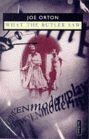
The Boy Hairdresser/ Lord Cucumber
5
Click to Order
5
Click to Order 6
5
Click to Order 6
Synopsis
Synopsis
Two novels marking the beginning and the end of the seven-year-long writing partnership of Joe Orton and Kenneth Halliwell. "Lord Cucumber" is a camp pastiche of a Mills and Boon romance, and "The Boy Hairdresser" tells of the tortured relationship of two rootless young men.
Synopsis
The fictional, diary of Susan Hope, an oddly innocent 24-year-old, a young
woman who desperately wants to become an actress, who leaves the drab Soho of the '50s for a dubious nightclub
engagement in Mexico, only to find herself the victim of the white slave
trade. A journey from the theatres of London to the bright lights of
Hollywood.
Synopsis
Fred & Madge' is based around a suburban couple who are not content with their dull lives. However this is a different 50s couple. Unsurprisingly Fred is unhappy with his job and despite the security it provides he decides to leave, while Madge dreams of working in an Indian harem.
Click on any book title to order that item

5
Click to Order 6
5
Click to Order 6
5
Click to Order 6
5
Click to Order 6
Synopsis
John Lahr reconstructs both the life and death of Joe Orton in another extraordinary biography that was chosen Book of the Year by Truman Capote and Nobel Prize- winning novelist Patrick White when it first appeared in 1978.
Synopsis
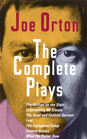
The Complete Plays: The Ruffain on the Stair; Entertaining Mr. Sloan; The Good and Faithful Servant; Loot; The Erpingham Camp; Funeral Games; What the Butler Saw.
Synopsis
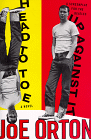
A novel, Head to Toe, plus a screenplay, Up Against It, that
was originally intended for the Beatles.
Synopsis
Note: this is not the correct book cover. Two likely lads make off with the swag from a bank robbery. In hot pursuit
by Inspector Truscott, who swears he's from the Water Board, and Fay, a
Florence Nightingale with the bedside manner of Boudicea, our intrepid
heroes are forced to bury the money in the last place anyone would
look....
Profile:
Controversial playwright and author of such black-humour farces as What the Butler Saw, Entertaining Mr. Sloane (1964) and Loot (1966). These are savage comic expressions of Orton's contempt for social institutions, as well as vehicles for his delight in shocking people. Joe Orton was 18 when he first met his future partner Kenneth Halliwell who was then 25. They met when Joe Orton joined the Royal Academy of Dramatic Art (RADA) in London, in May 1951. They were together for sixteen years until Joe Orton's death when he was aged 34.
Joe Orton moved in with Kenneth Halliwell in his flat at 161 West End Lane, London, NW6 in June 1951. In 1959 Kenneth Halliwell bought them a new flat at 25 Noel Road, Islington, London, N1. Kenneth Halliwell, remained a struggling, unpublished writer as Joe Orton's career rocketed. On 9th. August 1967 Halliwell bashed in Orton's skull with a hammer in their flat, and then killed himself with an overdose of twenty-two Nembutal sleeping pills washed down with the juice from a tin of grapefruit. Halliwell died first. On the desk near to Joe Orton's diary the police found the note: If you read his diary all will be explained - K. H. P. S. Especially the latter part.
The bodies were found by a chauffeur sent to collect Joe Orton for a meeting to discuss a screenplay that he had written for John Lennon and Ringo Starr. Orton's favourite song, "'A Day in the Life," by the Beatles, was played at his funeral.
"Joe Orton was born in the cold, dark, sooty industrial south side of Leicester in 1933 - a drab working class ghetto he referred to as 'the gutter.' The boredom and 'ugly banality' of his background, coupled with his inner sense at anger and isolation at being a homosexual in post-war Britain, fused in making him the most successful and feted playwright of international reputation in the 1960's." PAST LIVES, in Axiom News, 4th. December, 1997, p 7.
Reviews:
What the Butler Saw - Lecherous psychiatrist Dr Prentice is attempting to seduce a prospective secretary. But his wife promises the position to her own seducer, a blackmailing pageboy from the Station Hotel. His lust thwarted, Prentice must explain away a naked shorthand typist to the formidable Rance - commissioner for asylums, with power to 'hold sway over a rabbit hutch if the inmates were mentally disturbed.' But, as cross-dressing leads to increasingly crossed wires, the police search for the missing parts of Winston Churchill, and Rance aims for a hat trick of strait-jacketed maniacs within the hour, who can say what madness really is?
"Orton's farces make an audience confront the schizophrenic patterns of their lives, rather than evade them. By making a carnival of man's stupidity and superstition, by exposing the condition of social insanity, his plays hold out to an audience the possibility of humility and care. As a genre, farce has a power and insidious appeal which is becoming increasingly pertinent to our historical moment. Orton's plays, especially What the Butler Saw, pave a new way for playwrights to create dangerously with laughter in dangerous times. Orton's writing is a testament to what American society is just beginning to realize: reality is the ultimate outrage." Joe Orton: Artist of the Outrageous John Lahr (1973).
Britain's scandalous playwright of the 60's, Joe Orton, turned the stodgy West End theatre establishment on its ear. During his woefully short career, he wrote farces that were far beyond innuendo, and willing to take on any of the hitherto untouchable subjects, from sexual preference to gender to British reserve to the deified Sir Winston Churchill. His plays, such as his Loot and What the Butler Saw, don't just have teeth, they have fangs. Even today, one must be wary when mounting an Orton, knowing that everyone in the audience will be offended by something, but some people won't laugh at themselves as readily as others.
Loot - The play was given its first performance at the Arts Theatre Cambridge on February 1st 1965. It was described the next day in the Cambridge News as "A Comedy that brought so few laughs." Exception was taken to "Mr Orton's repetitive and nasty sense of humour." The play, although advertised as on a pre-west end tour, was withdrawn after six weeks of indifferent or hostile notices in the provincial press. The play was revived in April 1966 by Graham Murray at the University Theatre Manchester. It was then remounted by the London Traverse Company at the Jeanetta Cochrane Theatre in September 1966. The play was an overwhelming critical success and later transferred to the Criterion Theatre where it is still running. LOOT won the Evening Standard Drama Award as the Best Play of 1966.
Fred & Madge/The Visitors - Orton shows his early brilliance with these two contrasting pieces. This is a collection of two pieces by Joe Orton which so far are unperformed (I say so far because I know that OUDS will be performing 'Fred & Madge' in March 2000 at the Oxford Playhouse). 'Fred & Madge' is based around a suburban couple who are not content with their dull lives. However this is a different 50s couple - Fred pushes a boulder up a hill each day only to see it roll down and Madge sieves water in a bath. Unsurprisingly Fred is unhappy with his job and despite the security it provides he decides to leave, while Madge dreams of working in an Indian harem. The ensuing events represent the power of comedy rescuing a cast from the routine of their stage-bound lives (a fact which Orton, who himself once used to be a stage manager, demonstrates with characters that blur the boundaries of on and off-stage and the play's time-line). Soon London is demolished by the laughter of professional insulters, and the exotic East overruns a stylistically drab England.
This play is remarkable in many ways. It is remarkable that is was not published sooner - from the introduction to the text and from John Lahr's biography of Orton one gets the feeling that Orton wanted everybody to believe that 'The Ruffian on the Stair' was his first attempt to write a play and that when he shaved five years off his age and changed his name he became a completely new person. It is also remarkable in that it is different from other Orton works. Whilst some aspects remain very Ortonesque, the play toys with theatre's limits much more than later works and is free from some of the stock characters that populate later plays or the stricter farce structure he employs in Loot. However he compensates for this with fascinating levels of characters and some wonderful exchanges between characters who are obviously on different levels of depth and also of consciousness that they are on stage. The set is also very fluid - it starts with a virtually bare stage and Fred moving on and off all the props and set, but soon expands to have buildings being destroyed by greenery (offstage) and professional insulters (onstage) and the final scene demands the stage being transformed into a fantastical version of India. Bennet Summers
Prick Up Your Ears - John Lahr - New Yorker critic, novelist, and biographer of his father Bert Lahr (Notes on a Cowardly Lion) - reconstructs both the life and death of Joe Orton in another extraordinary biography that was chosen Book of the Year by Truman Capote and Nobel Prize-winning novelist Patrick White when it first appeared in 1978. "I have high hopes of dying in my prime," Joe Orton confided to his diary in July, 1967. Less than one month later, Britain's most promising comic playwright was murdered by his lover in the London flat they had shared for fifteen years. Lahr chronicles Orton's working-class childhood and stagestruck adolescence, the scandals and disasters of his early professional years, and the brief, glittering success of his blistering comedies. Prick Up Your Ears is a watershed biography; it paved the way for Orton's revival and ensured his rightful place in the English repertoire.
The Orton Diaries - "To be young, good-looking, healthy, famous, comparatively rich, and happy is surely going against nature". When Joe Orton (1933-1967) wrote those words in his diary in May 1967, he was being hailed as the greatest comic playwright since Oscar Wilde for his darkly hilarious Entertaining Mr. Sloane and the farce hit Loot, and was completing What the Butler Saw; but less than three months later, his longtime companion, Kenneth Halliwell, smashed Orton's skull in with a hammer before killing himself. The Orton Diaries, written during his last eight months, chronicle in a remarkably candid style his outrageously unfettered life: his literary success, capped by an Evening Standard Award and overtures from the Beatles; his sexual escapades - at his mother's funeral, with a dwarf in Brighton, and, extensively, in Tangiers; and the breakdown of his sixteen-year "marriage" to Halliwell, the relationship that transformed and destroyed him. Edited with a superb introduction by John Lahr, The Orton Diaries is his crowning achievement
Interview with Joe Orton - Taken from an interview with Barry Hanson in the programme notes of Peter Gill's Royal Court production of The Erpingham Camp and The Ruffian on the Stair (Crimes of Passion) June 1967.
"I was born in Leicester thirty-three years ago. Father a gardener, mother a machinist. I had quite an ordinary schooling. I didn't get my eleven plus. I wanted it at the time. So I left school and did this supposedly business course for a year, but it didn't do me any good because I'd no aptitude for keeping accounts and things like that... Yes, I was sacked from all the jobs I had between sixteen and eighteen because I was never interested in any of them. I resented having to go to work in the morning, and very often I didn't bother - I just looked in shop windows, or if it was a nice sunny morning I'd sit in the Town Hall square and have an ice-cream. At night I belonged to an amateur dramatic society, in fact I belonged to so many it got ridiculous - the rehearsals for the shows clashed."
"I wanted to be an actor but didn't know how to go about it so I wrote to the Information Bureau in Leicester. They said I'd have to go to R.A.D.A.. or some recognised dramatic academy and they gave me a whole list of elocution teachers . I went to one called Madame . . . . . , I don't know why they called her Madame, because there was nothing Madamish about her at all, she was just an ordinary, pompous middle-class lady and she didn't think much to me, just a yob, I could tell that; she offered coffee and I said yes, and she asked me did I take sugar and I said yes and she went away and came back with the coffee with sugar, but it wasn't sugar, it was saccharin in the bottom of the cup and so I thought 'Oh, yes, she's a right bitch' and she had these biscuits in a biscuit barrel, you know, these awful cheap biscuits. Oh, she didn't think much to me, she thought much more of a pompous, middle-class young man who was going to her because she thought he was going to be God's gift to the English stage and I was very glad to notice that he turned out to be a disaster. She had no taste."
"But she did tell me how to get a grant from the Education Authorities. She arranged an evening show of all her pupils to show how talented they were and I and this girl, her pupil, did the quarrel scene of Oberon and Titania from 'A Midsummer Night's Dream' and I had a marvellous idea. I thought I'd play Oberon green, so I bought a lot of green distemper from the local shop. I'd no idea about stage make-up, and put on a pair of bathing trunks and just covered myself from head to foot in green, including my hair, surprising I didn't get a skin rash; then I got a green bedspread from my mother's and father's bed and wrapped that round me and appeared on the stage in this fantastic outfit, the bedspread and covered in green distemper while the girl wore a conventional muslin ballet dress as Titania. Anyway, it was very successful because Madame introduced me afterwards to this man who was in charge of giving away grants, someone quite important and I had a long; talk with him and he thought it was all very interesting. Anyway they gave me a very generous grant ..."
"I did actually get into R.A.D.A. the first time. It was rather extraordinary. For audition I did a piece from Peter Pan between Captain Hook and Smee, I think it was, both at the same time, a schizophrenic act, it was quite alarming, I don't know how I did it. It impressed the judges and when I took the letter round to Madame she could hardly conceal her rage that I'd got in, and she continued to be bitchy, because when I went to R.A.D.A.. I was supposed to have had eight lessons, actually I'd had seven, and she kept writing and saying I hadn't paid her for the last lesson. I don't know if I ever did pay her."
I didn't have a very good time at R.A.D.A. really, because I found that in the very first term I actually expected to be taught something. It was complete rubbish. I wasn't taught anything and I learned at the end of the term that I was more enthusiastic and knew more about acting at the beginning of my first term than I did at the end. And during the next two terms, I had two years there, I completely lost my confidence and my virginity."
"Then I went into Rep for four months and I was bored; I did a lot of moaning; then I left the theatre and got married and that didn't work out. Well, I had no real feeling about it at all, it just didn't work out, I mean, I was too young ... we just drifted apart, no rows, I mean, those kind of marriages generally last. However one is liberal about modern marriage, there is this responsibility . I don't like possessions and a wife and children are possessions, they have to be possessed and supported. After a year I came back to London and started writing. I never wanted to be a writer, I always wanted to be an actor, but then I did have a talent for writing, but I never got anything published at all, never. I had to take lots of different kinds of jobs."
"I don't have a chip on my shoulder about having been sent to prison. I do know, however, that the kind of people who walked out of 'Loot' are the kind of people who are magistrates. Now they can't do anything about me as the author of 'Loot,' but when I was in their power, the same person before I wrote either "Loot" or "Sloane", then they could do something. No, I realise what I did was unforgivable, I'm just unrepentant. But I objected to public money going on dull, badly written books under the heads of successful lady authors on the backs of their book jackets. I think one was written by Lady Dartmouth. The libraries had a tremendous amount of space for rubbish but none for good books. I also used to write false blurbs on the book flap which the Magistrate described as mildly obscene. So they made an example of me. My activities had been going on for a long time."
"No, I liked prison. I mean the only things I had against it were the small things. When I was in Brixton, the lavatories were disgraceful, they were always overflowing and were in a filthy state: there weren't enough of them and that kind of thing. I was on remand, you see, so I didn't get out to work in the prison. I was locked in my cell for twenty-three hours a day. This didn't worry me much. I used to read a lot. Not the Bible, which we were supposed to read, but strange things like 'Hatter's Castle,' the sort of thing I'd never normally dream of reading, cheap novels and papers. I didn't trust the psychiatrist because I knew anything I told him would eventually be reported to the authorities."
"Well obviously you've got to have police they're a necessary evil. I mean I've no objection to them tracking down murderers and bank robbers, clearly you can't have people behaving in a completely anarchic way. I believe though, that they interfere far too much with private morals - whether people are having it off in the backs of cars, or smoking marihuana, or doing the interesting little things that one does. Oh no, they don't terrify me because I know how to deal with them. For instance, you never tell them the truth, you tell the most convenient lie, but one which they'll believe. And, of course, you're awfully nice. I mean, whey they got me into the police station the best thing to do, I found, was to be as nice and utterly vulnerable and open as possible, because it's no good standing on your rights once they've got you in their power. It may be cowardly. Well, I wasn't actually beaten up, but he hovered around... whereas if you mess them about they get nasty." "I hope that the violence in my plays is not of an inconsequential nature, I mean, not violence for its own sake. I'm always horrified by violence in some things, especially American films and novels. I watched an American series on T.V. called "The Invaders" and the violence in that seems to me purely gratuitous. I mean, it was necessary for the old man in 'Sloane' to be beaten up on the purely pragmatic grounds of the plot and I couldn't have had the play working otherwise, in the same way to go back to the old cliche about Shakespeare; you can't have certain scenes in 'King Lear' without having Gloucester's eyes put out. No, violence for its own sake I'm very much against.
"The style isn't super-imposed. It's me. You can't write stylised comedy in inverted commas, because the style must ring of the man, and if you think in a certain way and you write true to yourself, which I rope I am, then you will get a style, a style will come out. You've only got to be sitting on a bus and you'll hear the most stylised lines. People think I write fantasy, but I don't; some things may be exaggerated or distorted in the way some painters distort and alter things, but they're realistic figures. They're perfectly recognisable. I don't like the discrimination against style that some people have, every serious writer has a style. I mean, Arnold Wesker has a style, but people don't normally think of him as a stylist, in the same way they think of Wilde, Firbank or Sheridan. Style isn't camp or chi-chi. I write in a certain way because I can express in naturalistic terms. In the whole naturalistic movement of the 20's and 30's you can't ultimately have anything except discussions of Mavis's new hat; you can't have people. With the naturalistic style I couldn't make any comment on the kind of policeman that Truscott is, or on the laws of the Establishment. Oscar Wilde's style is much more earthy and colloquial than most people notice. When we look at Lady Bracknell, she's the most ordinary, common direct woman, she's not an affected woman at all. People are taken in by 'the glittering style.' It's not glitter. Congreve is the same. It's real - a slice of life. It's just very brilliantly written, perfectly believable. Nothing at all incredible."
"In spite of all one hears to the contrary, critics are human beings, and human beings make snap judgments. People always like to put you in compartments and I didn't like this. I think compartments of any kind are bad. They do it in sex 'he's a leather fetishist ' or 'he likes little girls in pink knickers'. Well, I think one should like everything, or try everything in all spheres of life. I don't think one should reject any experience - although I don't really fancy being beaten or anything like that."
"Yes, I was approached to do a film script for the Beatles. I said it would have to be an absolutely original script. Paul McCartney said do whatever you like. I said that means you'll never be able to do it. He said as long as it's good, that's all right. So I did the script and I was very pleased with it and my agent was very pleased with it and she's not an easy woman to please. Well, we sent it away and didn't hear anything for over a month, then we finally get this little note from Brian Epstein, that it wasn't suitable for the Beatles. Well, what did they want? They got a brilliant script. There were, of course, certain things. Because all teenagers were supposed to imitate the Beatles I mustn't have the Beatles doing certain things. I wrote a story, but actually as it turned out, by page 25 they had committed adultery, murder, dressed in drag, been in prison, seduced the daughter of a Priest, I mean the niece of a Priest, blown up a war memorial and all sorts of things like that. I can't really blame them but it would have been marvellous. I only wrote it because I wanted to, I don't have to be careful about what I write. The fact that Brian Epstein says it isn't suitable doesn't worry me, I'll do it an sell it to someone who will. I mean, I hadn't used any foul language. I hadn't gone as far as I can go if I really wanted to. I was very good on that. Oscar Lewenstein thought it was the best thing I'd written and he has every intention of doing it."
"I've always wanted to do a film called 'Carry on, Jesus' which would be a send-up of one of the Hollywood movies, and one could cast Kenneth Williams as Simon Peter. The trouble with the 'Carry on' films is that they should be, even in their own terms of reference, better. There are lots of terribly funny jokes we could make about tools and things like that, you know, all the postcard humour, but I never think it's good enough at present."
"I always rewrite plays. I get an idea and I do several drafts of it. What I usually do is to put it away for a while and then do a final rewrite. In fact 'The Ruffian on the Stair' was written in 1964 and the B.B.C. did it. But the version we're doing in 'Crimes of Passion' is only very vaguely like it, because since then I've had a whole new idea, although the skeleton is the same, a lot of it is totally different and totally new and I'm now satisfied that that is as far as I can go in this particular play and I don't want to do anything on it ever again so that I've got that out of my system. It's the same with Erpingham Camp, because I did a version of it for television. It all began when Lindsay Anderson gave me this idea . He said he was doing a film which he'd got from the Bacchae. He asked if I could do anything with it. 1 said I'd like to and went away and wrote 17 pages. Lindsay read it, but it wasn't his idea any longer, so I was left with the 17 pages, but what I'd done had really interested me so I turned it into a play for television, and when television had finished with it , there was another gap of a year, by which time I'd thought about it a lot more in stage terms, and I completely rewrote the characters. Now I've got that out of my system."
"I like pop music. I collect old records and new ones on the basis that they may become part of pop history. That's all I'm interested in because I don't like classical music. There was a time when I tried to educate myself to liking it, but I just think it' s a noise � a terrible racket, probably because I'm tone deaf. I love all those stupid songs like 'Marta, rambling rose of the wildwood'. I've just bought a record of Carl Brisson where he does a scene from "The Merry Widow"., it's utterly ludicrous but he does it in style and it's true to itself. It's very moving. I have an old record of Cavan O'Connor singing 'Kathleen Mavourneen' and it's really rather sad as well as being ridiculous."
"People have said I'm anti-Catholic: I'm not really, I just think they're very funny. I've never really come into contact with any dangerous Catholics. Those I've known have usually been Irish and I like the Irish, I don't know why. I mean, they're the most infuriating people on earth. I've never been to Ireland. I lust have a sort of irrational feeling about them."
"There have always been reactionaries, I think it's a mistake to call them Fascists because that really only applies to a certain period in history. Where people go wrong when they talk about fascism is that they always think of the Nuremberg Rally and there is really nothing wrong with the Nuremberg Rallies, the emotion, the bands and marching and all that, I mean they're marvellous, I get really involved and very emotional, but it's the purposes to which these things are put that's always evil. And the jackboot; it's a symptom of that particular country. I mean if you really wanted to spot the nasty equivalent of fascism in England you have to read the letters to the Radio Times and the T.V. Times. The B.B.C. is, for instance a monstrous propaganda organisation, the worst since Dr. Goebbels. It did give me my first encouragement in that it accepted 'The Ruffian on the Stair'. In a small enclave of the B.B.C. there are people who are fine, the Third Programme. They are genuinely liberal. I don't like the sort of liberal that is the reactionary underneath, you know the kind of Pamela Handsford Johnson liberalism. There's a lot more wrong with the world than teenage sex and drug taking."
"England, I don't know what will happen to it. I think there's a certain section of England that's marvellous. You can call it swinging London, but it just sort of expresses something that is there, a splendid liberalism, but only in a certain little bit of London. I mean, in New York, when Dudley Sutton was in 'Sloane' and had to have his hair dyed, it was very embarrassing. People actually passed remarks in the street, whereas they wouldn't here. You can do all sorts of things in London, and long may it remain so. "
[Lynda Page] [Sue Townsend] [Julian Barnes] [Max Wade-Matthews] [Clive Collins]
[Jane Adams] [Patricia Wendorf] [Joe Orton] [Colin Wilson] [John Thomas Edson]
[Referral Programmes] [Wartime & Miscellaneous] [Home Page]
[TOP]