

Book Review
~ Books by Leicester Author Colin Wilson ~
(In association with Amazon.co.uk)


Click on any book title below to order that item
[Lynda Page] [Sue Townsend] [Julian Barnes] [Max Wade-Matthews] [Clive Collins]
[Jane Adams] [Patricia Wendorf] [Joe Orton] [Colin Wilson] [John Thomas Edson]
~ Colin Wilson ~
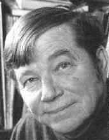
The original "Angry Young Man." Born Colin Henry Wilson in Leicester in June 1931; his father was a worker in the Boot and Shoe industry. Considering himself a genius, a born writer, and an outsider, Wilson found little value in formal education and left school at the age of sixteen. During the next few years he drifted and traveled around England and the continent. The period 1950-56 was marked by economic deprivation, marital difficulties (he was originally married to an Earl Shilton girl) and general discomfort. His first book The Outsiders was published in 1956. Colin Wilson has written upwards of thirty novels including: Ritual in the Dark, The Girl in the Labyrinth, The Schoolgirl Murder Case, The Personality Surgeon, Adrift in SoHo and his autobiography Voyage to a Beginning. Colin Wilson burst onto the literary scene in 1956; since then he has written over 100 books in nearly every conceivable genre. In an interview, further down this page, he talks at length about what led him to become such a prolific writer and about the ideas that run throughout his work.
Disclaimer: The New Age content of the following publications is not representative
of the spiritual philosophy of the editor of "The Market Place."
Click on any book or title to order that item


5
Click to Order 6
5
Click to Order 6
5
Click to Order 6
5 Click to Order
Synopsis
First published over 30 years ago, this book rationalizes the psychological dislocation so characteristic of western creative thinking into a coherent theory of alienation, and defines those afflicted by it as a type: "the outsider". Through the works and lives of various artists - including Kafka, Camus, Hemingway, Hesse, Lawrence, Van Gogh, Shaw, Nietzsche and Dostoyevsky - the psyche of "the outsider" is explored.
Synopsis
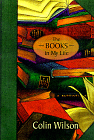
Author Colin Wilson is the author of more than 50 titles. In this "auto-bibliography," Wilson shares the books that shaped his life and challenged him to learn. This book - which won third prize in the Memoirs category in the Book of the Year for 1998 contest sponsored by Independent Publisher magazine - shows some of the most important influences on this highly intelligent, always fascinating, author.
Synopsis
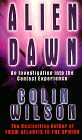
Colin Wilson analyzes the evidence for extra-terrestrial contact and
argues that aliens are real, and manifesting themselves on earth through
the human mind. To a newcomer to this topic the book provides a
great example of what Colin Wilson does so well in his Non fiction books.
The book is well researched and presents a broad spectrum of contact
experiences and of the players and thinkers in this field.
Synopsis
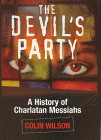
An illuminating study of the minds of messiahs and their disciples, which broadens to include more familiar personalities, such as Freud and Comte. The insights this book provides are numerous, and Wilson provokes one to think about both the subject matter and more general issues as well. The broad range of case studies he draws upon are both fantastic and interesting - the book makes for compulsive reading.
Click on any book title to order that item


5
Click to Order 6
5
Click to Order 6
Jack The Ripper - The Simple Truth
5
Click to Order 6
5
Click to Order 6
Synopsis
Starting with the excesses of Ancient Rome, the author introduces a gallery of killers, looking at each century and its preferred methods - from Jacobean witch hunts to the gangland killings of the Jazz Age. He looks at motives and methods, up to the 1990s spree killing and serial murders.
Synopsis
This collection has over 70 chapters which deal with such subjects as arson; blackmail and conmen; mass murder, mad messiahs and murderous millionaires; sabotage, stick-ups and suicide.
Synopsis
The identity of the most notorious murderer of all time has long remained a mystery. After 12 years of research, Bruce Paley believes he has uncovered the real face behind the chilling murders of Jack the Ripper. In this book, Paley presents the evidence he has collected and identifies his suspect.
Synopsis
From Jim Jones to the Mormons, from Tokyo to Waco, this book studies
charismatic leaders and their religions, and investigates their
psychology. The author draws patterns between the psychology of cult
leaders and serial killers.
Click on any book title to order that item


5
Click to Order 6
5
Click to Order 6
5
Click to Order 6
5
Click to Order 6
Synopsis
Every summer solstice thousands of pilgrims gather at sacred sites: Stonehenge, Machu Picchu and many others to pay respect to the past, hoping perhaps, to merge in some way with the mysterious power represented by the great megaliths. Today it is assumed that these sacred sites were built by local people for local reasons.This in turn implies the existence of an advanced civilization... continued below
Synopsis
Recent discoveries of ancient water damage to the Sphinx have thrown the scientific world into a tizzy with the suggestion that Egypt's legendary monuments might be thousands of years older than previously believed. In his astonishing new bestseller, Colin Wilson delves into these explosive new findings and takes us on a grand tour as he explores the knowledge amassed by researchers over the centuries.
Synopsis
A guide to the strangest things in the Universe, packed with lost lands, strange objects and peculiar happenings. Encounter the sinister Skull of Doom and the famous Turin shroud. Discover strange circles and explore the Earth's secret energies. Find out about mysterious disappearances in the Bermuda Triangle and study eyewitness photographs of weird monsters and a shy Bigfoot. Do they really exist?
Synopsis
Examines various explanations and evidence related to UFO sightings and alien encounters throughout history. Presenting vivid eyewitness accounts and amazing images of the weird and wonderful world of unidentified flying objects, this book reveals the world's UFO hot spots. You can examine the evidence of close encounters and alien abductions, consider the evidence and decide for yourself.
Reviews:
The Outsider - The seminal work on alienation, creativity, and the modern mind-set. First published over thirty years ago, it made its youthful author England's most controversial intellectual. The Outsider is an individual engaged in an intense self-exploration - a person who lives at the edge, challenges cultural values, and "stands for Truth." Born into a world without perspective, where others simply drift through life, the Outsider creates his own set of rules and lives them in an unsympathetic environment. Through the works and lives of various artists - including Kafka, Camus, Eliot, Hemingway, Hesse, Lawrence, Van Gogh, Nijinsky, Shaw, Blake, Nietzche, and Dostoyevski- Wilson explores the psyche of the Outsider, his effects on society, and society's effect on him. Wilson illuminates the struggle of those who seek not only the transformation of Self but also the transformation of society as a whole. The book is essential for everyone who shares Wilson's conviction the "a new religion is needed." "An exhaustive, luminously intelligent study . . . a real contribution to our understanding of our deepest predicament." Philip Toynbee
The
Books In My life - Wilson, who shares
his home with over 20,000 books, pinpoints the books that have made a
difference in his life and challenged him to learn. This book shows the
literary influences on Colin Wilson.
I have been an avid Colin Wilson fan since coming across The Mind
Parasites back in 1970, so I was particularly happy to be able to publish
his book. His fans all know that he is seemingly incapable of writing a
dull page, and he apparently wakes up each morning filled with enthusiasm
for ideas. This book - which won third prize in the Memoirs category in
the Book of the Year for 1998 contest sponsored by Independent Publisher
magazine - shows some of the most important influences on this highly
intelligent, always fascinating, author.
Rogue Messiahs - Prolific ruminator and kooky novelist Wilson undertakes to find a more or less universal explanation for the phenomenon of self-proclaimed messiahs. Such saviors need not be divine. One chapter considers "The Psychiatrist as Messiah," for instance, indicating that Wilson's coverage takes in persons who profess or exhibit the ability to bend followers' minds, usually with some promise of some sort of salvation as a lure. So Freud shares the spotlight with Koresh, Manson, and Crowley, not to mention Joseph Smith, founder of Mormonism. Wilson accords each a brief but detailed profile. He writes with an urgency that surges through the book and bespeaks his apparent commitment to describing the totality or, at least, the metaphysical pith of each individual subject. In the introduction, he succinctly limns his initial sexual experience, perhaps as a way of cleansing his own soul before dissecting those of the assembled messiahs, which would be only fair. Damned interesting stuff on a devilishly vital and timeless subject. Mike Tribby Booklist
Mammoth Book of Murder - Proving once again that fact is scarier than fiction, British writer Colin Wilson presents this seam-bursting collection of depravity through the ages. From Ivan the Terrible to Jack the Ripper to Ted Bundy, this haunting cast of characters will have you leaving the lights on all night. Organized by century and types of killers--assassins, pirates, serial killers, and the like--the book traces the evolution of crime within the context of greater societal changes. The author blames the birth of sex crimes on too much leisure time in the 19th century and credits big cities and their crowded conditions for the emergence of the modern serial killer. He also offers a whirlwind tour of torture and cruelty in answering the question, "What makes a monster?" Wilson is one of the most prolific and eclectic writers of our time, with more than 80 books to his credit on subjects as varied as existential fiction, philosophy, the occult, aliens, and the life of Aleister Crowley. Though often dismissed by critics as an obsessive crackpot, Wilson maintains a large following around the world due to his captivating, conversational writing style and ability to synthesize an impressive amount of esoteric information. The Mammoth Book of the History of Murder is an illuminating volume on a dark subject, written by a born storyteller.
Jack The Ripper - The Simple Truth: Propelled by unexpected information released to the public under the 100-Year law, this book explains why the Ripper stole the heart of his last victim, and why he killed so many others. With these compelling deductions, the list of suspects is reduced to exactly one: Joseph Barnett, the spurned lover of Mary Jane Kelly, the final Ripper victim. Although the factual evidence for his hypothesis is small, the author deftly makes his case. This book is the kind of history that, if it's not true, it should be; it's just too good a tale. By rights it should be a movie by now. A more striking answer for the Ripper riddle has never been made. First-time readers would do better to read Sugden's unsurpassed "Complete History of Jack the Ripper," but those familiar with the case will find this book to be irresistibly insightful.
Alien Dawn: An Investigation into the Contact Experience - When bestselling writer Colin Wilson met Harvard psychiatrist John Mack at a conference in 1995, he was propelled on a journey of discovery into one of the most daunting mysteries of our time - the UFO phenomenon. Mack told Wilson of his work with people who beLieved they had been abducted by "aliens", and this conversation Launched Wilson on a full-scale investigation into everything he could unearth about mysterious and bizarre events related to "alien" visitations. Groundbreaking and compelling, Alien Dawn describes Wilson's own attempt to make sense of a vast body of documented research involving strange and unexplained phenomena, including poltergeists, lake monsters, ancient folklore, time slips, out-of-body experiences, mystical awareness, and psychic travel to other worlds. He studied the accounts of Uri Geller and Andrija Puharich, who were convinced they had been chosen by aliens to deliver a momentous message to earth. He probed into people's claims that they had experienced contact with beings possessing supernormal powers possibly from other dimensions.
The Atlantis Blueprint - Every summer solstice thousands of pilgrims gather at sacred sites: Stonehenge, Machu Picchu and many others to pay respect to the past, hoping perhaps, to merge in some way with the mysterious power represented by the great megaliths. Today it is assumed that these sacred sites were built by local people for local reasons. This in turn implies the existence of an advanced civilization that existed before the Flood. This knowledge was periodically lost and rediscovered: first by an unknown people and then by the Knights Templar. It is positive evidence for the existence of a lost civilization that preserved some of its great knowledge as a gift to future generations.
From
Atlantis to the Sphinx: Recovering the Lost Wisdom of the Ancient World
- Recent discoveries of ancient water
damage to the Sphinx have thrown the scientific world into a tizzy with
the suggestion that Egypt's legendary monuments might be thousands of
years older than previously believed. In his astonishing new bestseller,
Colin Wilson delves into these explosive new findings and takes us on a
grand tour of the knowledge amassed by researchers over the centuries. He
explores mysteries that have puzzled humanity since Plato: Was there an
ancient civilization, destroyed by a great catastrophe, whose survivors
built the Sphinx some 10,500 years before Christ? Did they possess a
knowledge system that could orchestrate the transport of stones weighing
thousands of tons, an accomplishment that still baffles modern engineers?
Wilson's tour takes us to the cave paintings of the Cro-Magnons, the
tortuous interior shafts of the pyramids, the Upper Amazon, and the
Gilbert Islands, touching on sources from Robert Graves's The White
Goddess to the I-Ching, to get to the ultimate nature of human
consciousness.
Interview:
My background was working class: my father was a boot and shoe worker who earned about three pounds a week throughout the 1930s - about ten dollars in modern money. He was a kind of determined anti-intellectual; he'd been a boxer for awhile, but he lost the fight that would have turned him into a professional. He was a born countryman, really, but unfortunately lived in a city [Leicester] and had to work in a factory all his life. The result was that there wasn't an enormous amount of money around. Fortunately, I was very bright at school, and won a scholarship to a secondary school, which is the kind you have to attend in order to go on to university. I'd become fascinated by science at the age of ten--I read nothing else for years, except science fiction, which I managed to get a hold of during the war, those old American magazine such as Amazing Stories, which you could get on exchange in various shops in Leicester. I wanted to become a second Einstein. Unfortunately, I left school without the necessary number of credits. I was invited to take the exam over again, but this was going to be several months away. So when I left school in July 1947, I went to work in a wool factory, which was the first job offered me by the employment exchange. It was heavy work, lugging around crates of wool, and I hated it - it started at six in the morning, finished at six in the evening, and it seemed to me to be completely exhausting and boring.
I had by this time discovered poetry - not at school, where we didn't get taught much of it, but through a book called Practical Knowledge For All, which I bought at a church bazaar, and which contained courses on all sorts of subjects, from aeronautics and biology to philosophy. So in this state of total depression at my prospects, at the notion of having to work like a bloody rat on a treadmill for the rest of my life at jobs I hated, I used to go home in the evening, completely miserable, take myself off to my bedroom, and read poetry. I'd start off by reading the most depressing poetry I could find, things like Eliot's "Waste Land" and "Hollow Men," James Thomson's "City of Dreadful Night," the poetry of Edgar Allan Poe, like "For Annie," in which he says the best thing is to be dead. But of course this poetry would exercise a kind of cathartic effect, so that after about a half hour of reading I began to get more and more cheerful, and I'd end up by reading poems like Milton's "L'Allegro" and the love lyrics of James Herrick. I was also at that time reading a great deal of Shakespeare, and I absorbed that the same way as everything else. I hadn't yet developed a dislike of Shakespeare because of his basic pessimism. And of course the other person I admired tremendously was Shaw; I read my way completely through Shaw from beginning to end.
Anyway, one day when I called at school to return some mathematics books I'd borrowed, the headmaster offered me a job as a lab assistant, and this seemed absolutely wonderful: doing school hours, not having to work Saturdays, etc. But I soon discovered, to my horror, that I'd completely lost interest in science! There were some ways I found school as depressing as factory: my physics master was a real bastard who took every opportunity to be nasty. In due course, the exams came and it became completely apparent that I'd lost my interest in science; the headmaster came and said, you know, do you want to stay and pull your socks up, and I said no it's no good, I'm sorry, I just don't have any interest in science anymore. So I left school. I went to the labor exchange and they recommended me to take a job in the civil service, in a tax office. I found that even more boring than the factory or school; there was nothing very interesting to do except sit and file tax forms. What I wanted to do was use my mind: I wanted to write. I had started a journal; I bought a huge notebook and just began pouring my thoughts and feelings into it - which is an excellent way of learning to write. I particularly poured my depressions into it, and one day when I'd been writing about my absolute fury with this bloody physics master, I suddenly decided to commit suicide. I went off to school, to the evening class in analytical chemistry; I went over to the reagent shelf, took down a bottle of potassium cyanide, took off the stopper, and I was about to swallow it when I suddenly had an extremely clear vision of a few seconds in the future, of a horrible burning in the pit of my stomach, and the realization that I would have done something irrevocable. Oddly enough, it was as if I were two persons: I could see this little idiot Colin Wilson with all his stupid emotional problems, but there was also me, and I didn't give a damn whether Colin Wilson killed himself or not--except that if he did, he'd kill me too! And quite suddenly I was overwhelmed by a tremendous feeling of exultation. I put the bottle back on the shelf and rejoined the other students, and for two days I felt an immense sense of euphoria, which only gradually leaked away.
Anyway, the civil service was a horrible bore; I took my exams and to my disgust passed them easily, and became an established civil servant. I went to a town called Rugby which was extremely peaceful and which I hated, and worked there in the tax office, disliking that as much as I disliked everything. By that time I was almost 18, and the time came for me to do my national service; I went into the RAF, where the first eight weeks were spent square-bashing, and suddenly I felt absolutely fine: I was using all my energies up, sleeping well at night, eating enormously, also doing a bit of writing when I got the chance, and life seemed much nicer. But unfortunately when the square-bashing was over they assigned me to an antiaircraft unit as a kind of clerk, and I was back in effect to the civil service. I got more and more bored and fed up, until finally one day, when I typed a letter and the adjutant suddenly shouted at me, this is absolutely filthy Wilson, aren't you ashamed of it, and I said furiously, no. The adjutant looked very surprised and told me to go and wait in his office, where to my surprise he was quite sympathetic and said, now you go and see the MO, and if he will say that you're emotionally unsuited to work as a clerk perhaps we can get you transferred into something you prefer. When I went to see the MO I suddenly had an inspiration: I told him I was a homosexual, which I wasn't, but I knew all about homosexuality because one of my closest friends in Leicester, a character called Allan Bates, was homosexual and sort of a cultured type, and we got on tremendously well. He always said he wanted me to be his lover and all the rest of it, but of course it did just not appeal to me.
To cut a long story short, within about six weeks I was out of the RAF. I had that feeling that fate was deliberately hunting me from pillar to post when I read those lines in W.B. Yeats: "They are plagued by crowds until / They've the passion to escape." I had the feeling that this was what fate was doing to me: plaguing me until I had the passion to escape. I vowed I would never again work in an office. The first thing I did was get a job at a building site; I felt at least hard physical labor was better than sitting in an office with that increasingly stifling feeling. My father was absolutely horrified at this job, and several others--I also worked as a nabby, which is a ditch-digger in America, and my father thought, my God, the clever one in the family, and here I was working as a nabby. The result was that one night he suddenly told me to get out; I borrowed a few pounds from my grandmother and pushed off on the road. I hitchhiked down to Kent where I got a job as an apple-picker, was allowed to sleep in a derelict cottage whose roof had huge holes in it, and after this, on to Dover, and managed to get across to France with less than a pound in my pocket. I spent some weeks in Paris at the so-called Academy of a man called Raymond Duncan, who was the brother of the famous dancer Isadora. He wanted to teach me how to live according to his principles which he called Actionalism, which is basically be as much of an intellectual as you like but be capable of building a house if necessary, or mending pipes, or anything else. And I quite agree with him actually, but it didn't work out: I got bored there. I was always bored because what I wanted was to be a writer.
I came back from France finally, got a job in Leicester in a steel foundry, and there I met the works nurse, a girl called Betty: she ended by inviting me back to her flat and I ended by seducing her. To once again cut a long story short, my parents insisted that I marry her, and so, again to my disgust, I found myself a married man at the age of 19. I went to London, succeeded in finding a home for us after a great deal of effort; Betty moved down and had the baby, a little boy, Roderick, but in those days landladies didn't like babies or pets, so we moved several more times over the next 18 months. At the end of this time Betty went back to stay with my parents while I stayed on to look for a place for us, by now thoroughly fed up with the whole business. I'd been working in factories throughout my marriage, and I was also busily writing. Betty borrowed some money from her mother so we could take a flat, and the Irish woman who was letting it seemed to me a nice person, but when we'd agreed to take it Betty sent me a telegram saying she'd changed her mind, simply because the Irish woman refused to have a legalized agreement; I assume she was probably right although I trusted the woman. And that really was the end of our marriage. I was quite relieved, and shortly thereafter I went to France, so I suppose technically speaking I deserted her, although in fact she'd written me a letter saying she was sick of the marriage too. I ended up in Paris; Bill Hopkins, a writer I'd met in London, came to join me there for a bit; he was trying to launch a magazine and wanted to explore French printers to see if they were cheaper. Finally, in August or September 1963 - I'd been separated from Betty since January - I came back and went to work in a large store in Leicester called Lewis'. On my first day there, the girl who took the new trainees up in the lift, she was a slim girl, I didn't find her particularly pretty, I thought her nose was rather large, but I expected her to talk with this horrible Leicester accent - the equivalent of the deep south accent in America - and in fact when she spoke with a sort of cultured voice, and she had the sweetest smile I'd ever seen, she absolutely beamed good nature. I was completely smitten, but I could see she'd had an engagement ring on, so I just suppressed this feeling of, you know, my God she's adorable, but in point of fact although she was engaged to a student she'd known at Trinity College Dublin and was about to go and marry him in Canada, things worked out so that she ended by coming to London with me instead. And of course we're still together after 44 years, largely because she's so good tempered - I'm not difficult too live with but I do tend to get rather impatient being a workaholic.
Anyway, I moved back to London, quit or got sacked from various jobs . . . I really had that feeling of being driven from pillar to post by sheer frustration. The frustration that had been going on for seven years seemed like it had been going on for eternity. I got the sudden idea: I was spending about three or four pounds a week on rent, but why didn't I instead buy myself a tent and sleep out in the open, in one of London's parks or something. And this I did. At first I slept in a field opposite the factory that I was about to leave, but then I realized the tent was rather visible and that it would be much simpler if I got myself a waterproof sleeping bag. I left all my books and that sort of thing with Joy, who'd started working in a big store down in Oxford Circus, and subsequently became a librarian. She also got thrown out of one lodging because the landlady objected to me turning up at about eight in the morning to have breakfast with her. (Joy also had a series of neurotic landladies.) Finally I began to go down to the British Museum and began to work on my first novel, Ritual in the Dark. I'd sleep on Hampstead Heath, leave at daylight and cycle down the hill to a little cafe where I could get tea and bread and dripping for about sixpence, and then go on to the British Museum and spend the day, for example, reading up on the actual accounts of the Jack the Ripper murder cases in the Times for 1888, because Ritual in the Dark was based on a sex killer. I discovered in the British Museum a book called The Sadist, which is about a sex killer who'd committed a number of murders in Dusseldorf during the 1920's, and I got this out and read it with absolute absorption, as it once again provided me with the kind of background I needed for my novel. I should mention that I'd started this novel when I was still married to Betty, and had gone around the East End looking at all the Jack the Ripper murder sites that still existed.
When the winter came, having got soaked once or twice, I was forced to move indoors again. And it was when Joy went home for Christmas--I didn't have enough money to go to Leicester - that stuck in my room, eating egg and bacon and tomato for my Christmas dinner, I suddenly got the idea for a book called The Outsider in Literature, and began taking notes for it in the back of my diary, which I still have. This got me quite excited; I wanted to show just how many Outsiders there are in literature, these people who you might call 'in-betweeners', people who are a little too intelligent to put up with the kinds of jobs and lives they're expected to endure in modern society, and yet not intelligent enough to be able to dictate their own terms. But I could also see that all people who are, so to speak, in the wrong place, in the wrong position, are Outsiders. So it was not only these people who fell between two schools, but people like Fitzgerald's Gatsby, who in practice is a bootlegger and a gangster yet who nevertheless is a total romantic. That was what fascinated me, the Romantics of the nineteenth century, and what has been called the eternal longing: this feeling that there must be a better way to live than this, that these moments of ecstasy, these moments of deep peace and serenity which I experienced when reading poetry, must be attainable on a more everyday commonplace basis. It seemed intolerable only to be able to experience this when reading poetry, or in what William James calls "melting moods," and have to spend the rest of your time working at some job you hate. Again, a character like Hamlet is a typical Outsider: he's stuck in a kind of emotional position which he finds completely disagreeable. I agree with Shaw's analysis of Hamlet, which is that according to the old code of morality he ought to be murdering his uncle and perhaps even his mother, and yet he instinctively feels that this is not the right thing to do; he's living by another code of morality, a higher code.
As soon as Christmas was over, I cycled down to the Museum to work on The Outsider in Literature, and as I was cycling there, I remembered a book I'd read by Henri Barbusse called Under Fire, about the first world war. It mentioned in the introduction that Barbusse had first become famous when he'd written a novel called L'Enfer - Hell- about a man living in a boarding house who discovers a little hole through which he can see into the next room, and he spends all his days watching the people come and go in the next room, and he really struck me as the archetypal Outsider, looking through a hole into other people's lives. So when I got to the Museum I found L'Enfer, read it through from about mid-morning until about three in the afternoon, and then simply copied out a passage of the book: "In the air, on top of a tram, a girl is sitting. Her dress, lifted a little, blows out. . . ." I found this very interesting because the sexual theme was basic in my work. Ritual in the Dark was about that; there was a scene in which the hero, Gerard Sorme, has spent the afternoon making love to his girlfriend about seven times, and is utterly sexually exhausted, and thinks, isn't it wonderful to be finally free of this perpetual sexual itch, and then he goes out to get the milk from the doorstep of the basement, and looking up can see up the skirt of this girl who's passing the area railings, and instantly experiences a wild desire. So I knew absolutely what Barbusse meant, this business about "It is not a woman I want - it is all women."
By this time, I was working in a laundry; it was sort of a dreary laboring job which involved lifting tin baths on and off a moving belt all day long, and if you weren't careful you slashed your hands because a lot of them were very rusty. What finally disgusted me with the laundry was, I had a pocket sized journal, which I filled with ideas and so on, and this was stolen one day; probably whoever stole it had opened it casually and seen some reference to sex, and took it away. I was so angry about this I even offered a reward, but it never turned up. So I gave my notice, went to the labor exchange, and was told that a new coffeehouse was opening in the Haymarket, and that they wanted a washer-up. So I signed on. And I found this a very pleasant job after all the previous jobs I had; quite suddenly fate had ceased to harrow me. Most of the other people working there were young drama students, and this was very pleasant; I'd always worked among working men and women, and to be around students hoping to become the great actor or actress was tremendously stimulating, and I felt perfectly at home among them, since I was determined to become a great writer. By this time I had written the first three chapters of The Outsider, starting off with Barbusse, then going on to talk about Sartre and then Wells' Mind at the End of its Tether. Fortunately my reading had been very eclectic; I'd also been lucky in stumbling upon the kind of thing that I needed. I'd admired Nietzsche since I was about 15, and had bound my copy of Thus Spake Zarathustra in soft leather so that I was able to carry it around in my pocket like a bible. The other book that deeply influenced me was the Bhagavad Gita, which I came across through a reference in T.S. Eliot. I found when I was 16, working in the lab at school, that if I sat and meditated for three-quarters of an hour a day, and that if I got up very early in the morning and took a long run and then walked into town to school instead of taking the bus, that I just felt much fresher and happier. I'd always been fascinated by religion, particularly by religions like Buddhism and Taoism. I'd had this desire to know everything, so when I came across a huge volume called The Bible of the World, I borrowed it and read huge chunks of it, and when I found an abridged edition called The Pocket World Bible, I carried that around with me for years. All of this was poured into The Outsider, as well as all my reading about existentialism: I'd discovered Kierkegaard, read Camus' La Peste when I was married, then came across his L'Estranger, which in England is translated as The Outsider. I also been fascinated by Van Gogh for years, and read his letters, and a life of him, and had books with reproductions of his paintings, and was really quite obsessed by him as well as by Beethoven. And George Fox, founder of the Quaker movement. All these Outsider figures were my heroes... If you are interested in the rest of this interview, go to the Rain Tree website: "Colin Wilson: Beyond The Outsider" --> [Link] Or, there is this link to "A short Biography of Colin Wilson" --> [Link]
[Lynda Page] [Sue Townsend] [Julian Barnes] [Max Wade-Matthews] [Clive Collins]
[Jane Adams] [Patricia Wendorf] [Joe Orton] [Colin Wilson] [John Thomas Edson]
[Referral Programmes] [Wartime & Miscellaneous] [Home Page]
[TOP]