|
|
||
|
|
||
|
|
|
|
|
|
||
|
|
||
|
Nostalgia Junction |
||
|
|
||











|
Memories of the Days of Steam (page 1A) Featuring the Railway Art of David Weston The following five paintings are featured in page 1A of Nostalgia Junction: |
|
[Master Cutler] [Golden Arrow] [The Iron Duke] [Arrival at York] [Swindon Pride] |
| The following five paintings are featured in page 1B of Nostalgia Junction: |
| [Great Western Splendour] [LNER 4472] [Cheltenham] [Leicester Shed] [Sunset Duchess] |
| The following sections are featured in page 2 of Nostalgia Junction: |
[B17/6 Leicester City] [Railway Posters] [West Bridge] [ Northgates] |
| The following section is featured in page 3 of Nostalgia Junction: |
| [Railway Postcards] |
| If any of the images get hung up and won't reload or refresh: in Explorer, go to Tools (Internet Options) then press delete files and clear history - then try refresh again. |

|
|
working like a
|
|
|
| Note: All railway art images below have been reproduced with the kind permission of David Weston and most (with exception of the Master Cutler) are available as prints from Lazy Acre Fine Arts Ltd. (Distributor of David Weston's prints) Hollingshead Yard, Nottingham Street, Melton Mowbray, Leicestershire, UK, LE13 1NW. Phone: 01664 812600 |
|
|
 railway "navvy"
|
The Master Cutler - Leaving Leicester Central on the GCR
|
|
Great Central Notes Tim Airey The famous Great Central Railway (GCR) passenger train the �Master Cutler,� was inaugurated on October 6th, 1947 and ran from London (Marylebone) to Sheffield (Victoria) with stops in Rugby, Leicester and Nottingham until it was re-routed in 1958. As a through route from Sheffield to London, the GCR was closed down on September 3rd, 1963 as part of what was known then as the �Beaching Axe.� In this painting by David Weston, he captures beautifully the romance of that named train in its heyday. Seen here shortly after leaving Leicester Central (background - left) at 8:31 pm, the Master Cutler (pulled by the Gresley A3 Pacific No. 60107 �Royal Lancer�) accelerates across the latticed, girder bridge spanning Northgate Street (see Northgates), passing the large signal gantry and then across the viaduct. Steadily building speed, it will be non-stop through the island stations of Belgrave and Birstall, Rothley, Quorn and Woodhouse, and Loughborough until it reaches Nottingham Victoria � just 30 minutes later (at 9:01 pm). The time period would probably have been the early fifties, since �Royal Lancer,� along with the �Flying Scotsman� and �Solario� did not arrive at the Leicester engine depot until 1950. |
|
Great Central Notes Extracts From �A Unique Anniversary� - Mark Fowler The Great Central was born of the Manchester, Sheffield and Lincolnshire Railway, a midlands- based company that already had a comprehensive network of routes from Liverpool in the west to the East Coast resorts. During the closing years of the 19th century the directors elected to push forward a plan so inspired that it seemed impossible: to build a main line to London. But not just any main line. This one would be easily graded and laid out for speed and efficiency. The result was a line with a ruling (maximum) gradient of 1:176, gentle curves and not a single level-crossing to hinder trains between Sheffield and London. Not that London was the ultimate goal. The whole of the "London Extension" was laid-out with a generous loading gauge. The MS&L directors had their sight firmly set on an eventual route right through to a new Channel Tunnel. The GC route would be the only one that would be able to accommodate continental rolling stock without expensive reconstruction work. With the start of the works, the MS&L changed their name to the grandiose title of "The Great Central Railway." Passenger services began from London on 15th March 1899. The GCR quickly gained an excellent reputation for being a fast, comfortable and efficient way of reaching the Midlands from London, and pioneering ideas such as buffets on the trains. The GC gave its trains grand titles: The Master Cutler and The South Yorkshireman being good examples. The route and its employees always viewed the world from an aloof position. The rival Midland route was serpentine and roller-coaster in nature. The London and North Western also had a curvaceous route to the West Midlands. The GCR crews were a unique breed, pushing their steeds at great speed along their flat, straight main line |
|
Footnotes: for a more comprehensive history of the Great Central Railway see the rest of the excellent fore going article A Unique Anniversary By Mark Fowler of the Loughborough-based Great Central Railway or visit Nick Bergquist's Great Central Website. For an ironic development, see the plans at the Central Railway PLC Website for re-instating large portions of the former GCR right-of-way for a proposed new railway between North West England and Northern France via the Channel Tunnel. Ironic indeed, considering that part of the vision of the builders of the original railway was to in fact provide just such a service. |

|
|
|
The Golden Arrow - The Pride of the Thirties at Victoria Station
|
|
Pullman Crest courtesy of the Bluebell Railway |
|
"Golden Arrow" was the name of the Southern Railway's all-pullman boat-train and not that of the engine. The engine in this painting by David Weston is the Lord Nelson Class locomotive No. 859, Lord Hood. The train's name "Golden Arrow" would appear on a headboard at the front of the locomotive. The "Golden Arrow" was considered the way to travel to Paris if you were wealthy or famous back in the period between its inception in 1929 up to the time when the service began to decline - the mid 1950s. The scene above, typical of the 1930s, and conjuring up images of an Agatha Christie novel, is of London, Victoria Station prior to the Pullman train's departure for Dover Marine Station at 11:00 a.m. The "Golden Arrow" operated in conjunction with the French "Fleche d'Or" which operated between Calais and Paris... TBA. Hauled at first by Lord Nelson class steam locomotives, the Southern Railway's all-Pullman Golden Arrow train started off as the "White Pullman" train which ran from London's Victoria Station to Dover from 1924. It became the Golden Arrow in May, 1929, with passengers enjoying special customs handling and their very own ship, the "Canterbury," for the journey across the Channel before boarding another train in France for the final leg of the trip to Paris Leaving London at 11 am, Golden Arrow passengers would arrive in Paris at 5.35 pm the same day. The Golden Arrow ceased during the Second World War but was restarted in 1946 when Bulleid Pacific steam locomotives started hauling the trains. The peak of the Golden Arrow was in 1951 - the year of London's Festival of Britain - when the impressive Britannia class steam locomotives started to haul the service and the train was given seven specially built Pullman carriages. However, from the mid-1950s, the service began a steady decline: its luxurious Pullman coaches were slowly replaced by ordinary carriages. The service was electrified in June, 1961, and ended in September, 1972... Courtesy of the Swanage Railway. |
|
|
|
The Iron Duke at Dent - Britannia Class on the Settle & Carlisle
|
|
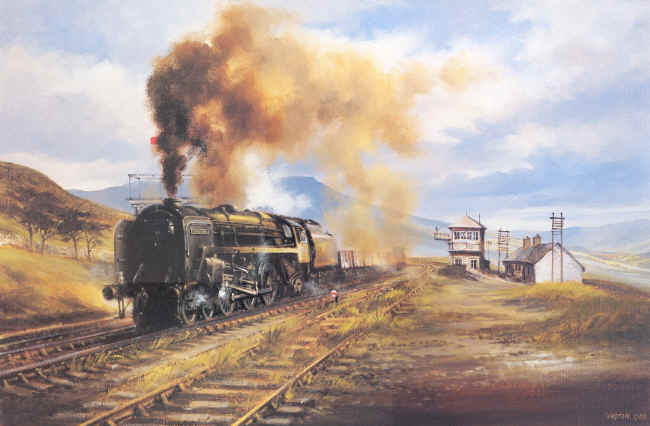
Seen here near Dent on the Settle and Carlisle railway between Ribblehead and Garsdale the Iron Duke - a Britannia Class locomotive - heads up a goods train as it approaches Dent Station. This station, at a height of 1150 feet above sea level, is the highest on a main line in England. The small station sits on a ledge some 600 feet above the actual village of Dent. Also in the vicinity is the Dent Head Viaduct, an impressive span of 10 arches, 100 ft high, and 199 yards long. It is the 4th highest and fifth longest of the 17 major viaducts on the Settle and Carlisle railway. This magnificent railway line, now thankfully spared, threads its way across the moorland that can change so quickly from beautiful and serene to bleak and forbidding. The Signal box at Dent, like the steamers, is now gone. Thirteen of the first fourteen Britannia Pacific's manufactured, were destined for the Great Eastern lines of the Eastern Region; 70014, Iron Duke, was allocated to the Southern Region for working the "Golden Arrow" boat-train from Victoria to Dover. Manufactured in June of 1951, Iron Duke was withdrawn from service in December 1967. The Britannias, or "Brits" as they were affectionately called, were planned by BR Locomotive Superintendent R.H. Riddles and his assistant E. S. Cox as the first of 12 standard classes of locomotives in the days before BR became committed to the idea of widespread diesalization. Ironically, the real Iron Duke (The Duke of Wellington) war hero and statesman, was supposed to have had an unhappy relationship with the railways - at least at first. It is reported, for instance, that he was present at the world's first fatal railway accident and that he was booed at the opening of the Liverpool to Manchester Railway. He is quoted as having said, in regard to railways in general: "Railways will only allow the masses to move restlessly and aimlessly about." However, later, Wellington changed his mind after he developed a close relationship with George Hudson (the "Railway King") who helped Wellington make a great deal of money by advising him when to buy and sell railway shares. |
|
Footnotes: For a little bit more of the history about the actual person for whom the engine was named, follow this link for an article by Spartacus Educational. This website also has some interesting railway trivia. For a comprehensive look at the history, design, development, allocation and engineman's impression of this class of locomotive, go to this very interesting site dedicated to Britannia 70000: [Britannia]. For a less technical but more nostalgic look at the "Brits," try the "Britannia Class Loco Cyber-Scrapyard" at this [Link]. Other related links are the Settle and Carlisle Railway, Dent Station and Dent Head Viaduct. |


|
|
|
Arrival at York - A4 Pacific Silver Link
|
|
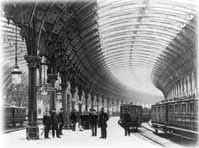
In this scene by David Weston, Sir Nigel Gresley's beautiful A4 Pacific Class Locomotive "Silver Link" is seen arriving amidst the sunlit splendour of York's elegant station. In order to accommodate trains arriving in York from all directions, it was decided in 1873 to build a new station in the city. The station was extensively enlarged in 1877 making the 13 platform York Station the largest in the world at that time; it was also considered to be one of the great buildings of Victorian England. York Station was designed by William Peachey and Thomas Prosser. |
|
Footnotes: York station was originally built to accommodate trains on the York & Midland Railway and the Great Northern Railway entering York. |
|
The age of the train! by Chris Titley at York Railway Station, June 25, 1877
(A newspaper article regarding the opening of York Station)
|
|
York's new railway station, with its magnificent glass roof York�s new railway station opened today to great public acclaim. The first train left for Scarborough on time at 5.30am. Services then continued throughout the day. It was a colourful scene. Crowds milled on the new platforms to see the imposing locomotives arrive and depart. Most of the engines were in the green North Eastern Railway livery, the different shades allowing us to guess which of the company�s four locomotive works had carried out the work. Passengers filled the first and second class NER coaches, in their distinctive dark plum shade, and were packed into the dark green third class carriages. The city can take pride from this magnificent station. It is the largest in Britain, a building which confirms our city as being at the heart of the country�s railway network. Railway bosses and guests at the grand opening were lost in admiration for this architectural achievement. The magnificent train-shed roof is an incredible 800ft long and 234ft wide, with the largest span, over the through tracks, measuring 81ft. The wrought iron roof ribs rise to 42ft above the platforms, and are held in place by cast-iron columns. And the main platform is fully 1,500ft long. Owners North Eastern Railways have not given an exact cost for the station, but it is said to have cost �400,000. There was only one dissenting voice at the grand opening. One NER shareholder called it �a very splendid monument of extravagance.� But railway chiefs and the travelling public will be delighted by the new station. For 30 years progress in York has been stymied by an inadequate station. The city can trace its railway heritage back to 1835 when the York & Midland Railway Company was formed, largely under the influence of the late George Hudson. The disgraced �Railway King,� as he was once known, realised the potential of this wonderful form of transport and vowed to �Mek� all t�railways come t�York!� By the late 1830s, construction of the York & North Midland line was progressing well. So well, in fact, that a makeshift wooden station had to be built. This served its purpose until 1841 when York�s first station-proper was built just inside the city walls. The land was previously occupied by a Hospital for Poor Women (since relocated to St Saviourgate), York Corporation�s House of Correction and Backhouses Nursery. Hudson had persuaded the Great North of England Railway to build its line from Darlington to York, instead of Leeds, and the station was designed by local architect George Townsend Andrews. Traffic at the station increased rapidly, soon placing it under strain. Rail access was restricted by the size of the archway through the city walls. And these difficulties were exacerbated by the fact that the station was a terminus. Trains between north and south had to reverse direction before continuing their journeys, causing delays and congestion. But although permission for the new station was obtained from Parliament in 1866, it has taken 11 years to reach this momentous day. The North Eastern Railway�s architect Thomas Prosser drew up the original plans for the station. He based his design for the train-shed on that produced by John Dobson for Newcastle Central Station, with some features derived from the roof at Paddington, partly designed by Isambard Kingdom Brunel. Mr Prosser did not oversee the project to its completion, retiring in 1874. His successor, Benjamin Burleigh, sadly died in 1876, leaving final supervision of the York Station contract to William Peachey. Disputes and a strike by workmen held up the construction in the early part of this decade. But now we have a station of which we can be proud. In order to accommodate trains arriving in York from all directions, it was decided in 1873 to build a new station in the city. The station was extensively enlarged in 1877 making the 13 platform York Station the largest in the world at that time it was also considered to be one of the great buildings of Victorian England. York Station was% designed by William Peachey and Thomas Prosser. The station was originally built to accommodate trains on the York Midland Railway and the Great Northern Railway entering York. Courtesy of A thousand years in York's History (The Evening Press and This Is York). Sir Nigel Gresley introduced the famous wedge-shaped A4 class Pacifics in September 1935 to pull a new purpose- built high-speed train called the Silver Jubilee, running between London King's Cross and Newcastle, in celebration of King George V's 25th year of reign. On a demonstration run the streamlined A4 Class locomotive Silver Link (seen above at York Station) hauled the train at a world record speed of 112.5 mph. During 1937 intense rivalry developed between LNER's Coronation, a streamlined loco operating on the London to Edinburgh route and LMSR's Coronation Scot, a streamlined Pacific class loco designed by William Stanier, operating from London to Glasgow. Nigel Gresley decided to go for a record that would not be beaten, even by the Germans who had achieved 124.5 mph in 1936. He chose his newest A4 Mallard which in a special trial on 3rd July 1938 along a stretch of track north of Grantham touched 126mph - a world speed record for steam that would never be broken. |
|
Footnotes: The foregoing is partly courtesy of The History of the Railway. Other useful links: A4 class Pacifics, William Stanier, Sir Nigel Gresley and Mallard. |
![Arrival at York [Silver Link] by David Weston](/images/York1.jpg)
|
|
|
Swindon Pride - King Edward I
|
|
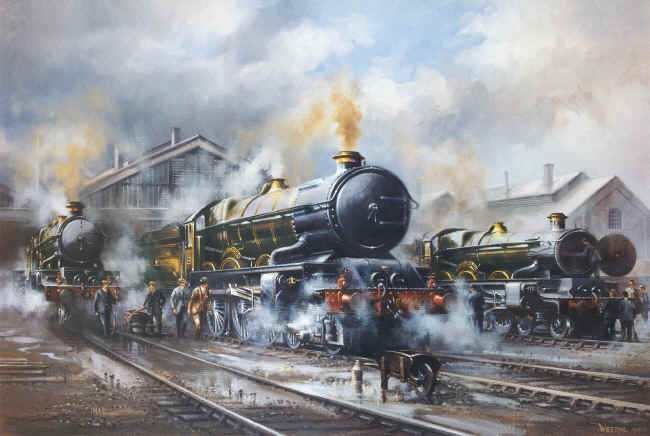
The proud days of the Great Western Railway are vividly recalled in this nostalgic and evocative scene of Swindon yard and sheds in the late thirties. Beautiful polished and powerful locomotives are made ready for the road in the Swindon yard, whilst the locomotive inspector together with a proud and equally fastidious driver does a final check on King Edward I. Designed by C.B. Collett, the King's represented the ultimate development of Churchward's four cylinder concept and were the heaviest (at 135.7 tons) and the most powerful (at 40,300 lbs tractive effort) 4-6-0 locomotives ever to run in Britain. This class of locomotive was designed to fill a need whereby the GWR could remain competitive with the other great railways in Britain. The first of the King class (No. 6000) rolled off the assembly line in 1927 at the Swindon works. Built for use on express passenger services such as the "Cornish Riviera Limited" and the Bristolian, the King class locomotives regularly reached 100 mph in every day routine service. Only three "King class locomotives were saved for preservation: No. 6000 King George V, No. 6023 King Edward II and the above centre locomotive No. 6024 King Edward I. The latter was withdrawn from service in 1962, and like so many others, sold to one of the locomotive graveyards: the Woodham Brother's Scrapyard in Barry, South Wales. There she sat for 11 years until purchased by the 6024 Preservation Society in 1973. However, it took another 16 years to get her back to mainline running condition making her first run in 1989. You can hear the sound of this preserved locomotive by following this link to The Great Western Archive, and scrolling down the page until you get to King Edward I.
Swindon was the first of the great railway towns and always the technical nerve-centre of the Great Western Railway. Some argued that the workshops of the new railway should be built exactly midway between London and Bristol, but Isambard Kingdom Brunel and Daniel Gooch, the Locomotive Superintendent, had visited Swindon in 1840 and had chosen a site at the junction of the branch line to Cheltenham and the Great Western main line to Bristol. The decision to site the Great Western Railway's Workshops at Swindon was made in 1841 when the Board of Directors authorised the construction of "an establishment commensurate with the wants of the company." The area chosen was some distance from the town of Swindon in green fields a short distance from the Wilts & Berks Canal. as well as being a junction as already mentioned. West of the town Brunel's line scaled ferocious gradients including 1 in 100 through Box Tunnel and Wootton Bassett Incline. Gooch planned to run his 7ft single-wheeler flyers on the level way which Brunel had laid between Swindon and London and to use engines with smaller driving wheels on the section between Swindon and Bristol with its steep gradients. Swindon, it was argued, was therefore the obvious place to change locomotives on the Bristol-London trains, and it was also in terms of engine revolutions per mile, the exact halfway mark. - Courtesy of the Great Western Railway Museum Swindon. |
|
Footnotes: For more on the Museum, the Swindon Story and the men who built the Great Western Railway, go to this first class website: Swindon's Heritage. For more on the history of the GWR in general, see GWR History 1835-1900 and GWR History 1900-1948, courtesy of The Great Western Archive. Other links: Engine designers C.B. Collett, and Churchward, the 6024 Preservation Society, The Great Western Archive and the engineer Isambard Kingdom Brunel. |

|

|
[Master Cutler] [Golden Arrow] [Iron Duke] [Arrival at York] [Swindon Pride] [Great Western Splendour] [LNER 4472] [Cheltenham] [Leicester Shed] [Sunset Duchess] [B17/6 Leicester City] [Railway Posters] [Railway Postcards] |
||
|
|
||
|
Get Paid to Surf and Work:
I run this one the most, and it's now my favourite (I'm so fickle). The reason is that you not only get paid for any time on the computer, you can actually be away from it for up to half an hour at a time and still be paid. You do have to log back in every 30 minutes though (a simple click suffices). Stable and no trouble to run. Desktop Dollars: pays a percentage of the total company advertising revenues. The actual pay rate is estimated at $0.50 an hour for running a program that shows you ads and your monthly surfing hours are unlimited.
Another pretty good one, and I run this one fairly consistently as well. It only pays when you are both active at the computer (not just surfing) and moving the mouse (at least every minute). It doesn't work when you are doing a lot of straight typing however. You also have to click on a number of ads, but not a great many. Good (instant) stats available. Limitations: It's a bit big for my liking; however, this is the beta version, so maybe they will make the final version thinner.
|
||
|
NOTICE:
Please check out the new section [The Market Place] for information on "Paid to Surf" or other referral programs: I have chosen these types of programmes because I spend a lot of time on line, managing and doing research for Leicester Overseas, writing and answering E-mails and just plain old surfing. So why shouldn't I (or you for that matter) get paid to surf and for other times spent at the computer. |
||
|
|
||
| | Prev 5 | Prev | Next | Next 5 | Random | List | Join | ||
|
|
|
|
|
West |
|
East |


|
||||||||||||
|
||||||||||||
|
|
||||||||||||
| Drop Me A Line! | ||||||||||||
|
|
||||||||||||