|
|
||
|
|
||
|
|
|
|
|
|
||
|
|
||
|
Nostalgia Junction |
||
|
|
||











|
Memories of the Days of Steam (page 1B) Featuring the Railway Art of David Weston The following five paintings are featured in page 1B of Nostalgia Junction: |
| [Great Western Splendour] [LNER 4472] [Cheltenham] [Leicester Shed] [Sunset Duchess] |
| If any of the images get hung up and won't reload or refresh: in Explorer, go to Tools (Internet Options) then press delete files and clear history - then try refresh again. |

|
| Note: All railway art images below have been reproduced with the kind permission of David Weston and most (with the exception of the Master Cutler) are available as prints from Lazy Acre Fine Arts Ltd. (Distributor of David Weston's prints) Hollingshead Yard, Nottingham Street, Melton Mowbray, Leicestershire, UK, LE13 1NW. Phone: 01664 812600 |
|
|
| Great Western Splendour
- Isambard Kingdom Brunel
|
|
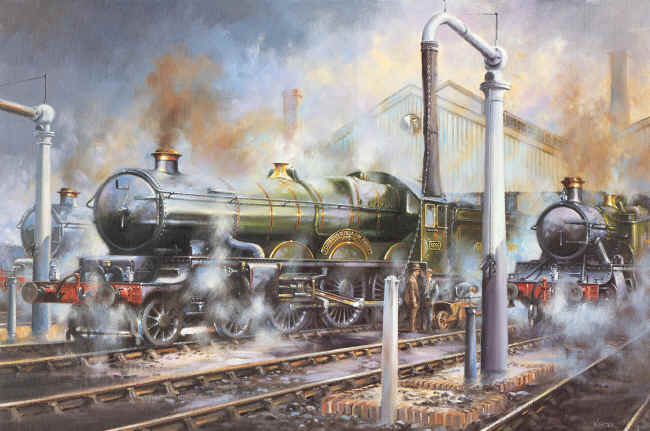
The Great Westerns true splendour lay in both the design and condition of their magnificent fleet of express locomotives. The setting for this painting by David Weston was designed to compliment that of the Swindon Yard in the previous scene. The setting above is that of the Didcot yard and shed sometime in the late fourties with the superb Castle Class locomotive No. 5069 "Isambard Kingdom Brunel" ready for the road - alive with steam and latent power. Besides this great engine, a 2-6-2 tank engine simmers alongside to make another nostalgic and evocative scene of the Great Western Railway in its heyday - and at its very best. Altogether, 171 Castle class locomotives, designed by C.B. Collett under the standardisation plans of G.J. Churchward, were built between 1923 and 1950. The first was numbered 4073 Caerphilly Castle. Only eight of this class of locomotive have been spared the graveyard and the ultimate indignity of the cutters torch. We can be thankful for this, as we can for so many others of the many preserved locomotives around today, because of the actions of Woodham's scrapyard in Barry. Rescued from that yard were No. 4073 Caerphilly Castle, No. 4079 Pendennis Castle, No. 5029 Nunney Castle, No. 5043 Earl of Mount Edgcumbe, No. 5051 Earl Bathurst, No. 7027 Thornbury Castle, No. 7029 Clun Castle but not alas No. 5069 Isambard Kingdom Brunel. Didcot, which was on the GWR route from Bristol to London is an active railway preservation site today. Their activities have been recognised within the railway preservation movement, gaining the "Association of Railway Preservation Societies" award for outstanding achievements in 1975 and in 1981. Other major awards have also been received for Didcot Halt and the signalling project. The restoration and operation of the Travelling Post Office won a top prize in the Scannia Transport Trust awards in 1997. Isambard Kingdom Brunel was born in 1806 at Portsea. His mother was English and his Father French. Isambard was educated at Hove near Brighton and at the Henri Quatre in Paris. Engineering was in his blood and he gained experience by working as an apprentice with Breguet, the French precision instrument maker and later with the family engineering office and also with the Maudsley Engineering works. In 1823 Brunel joined his father, Sir Marc Brunel, and his firm the Thames Tunnel Company which was building the first tunnel under the River Thames. Isambard was appointed Resident Engineer but nearly lost his life during the second flooding of the tunnel and his father was nearly made bankrupt. The tunnel is still being used today by the London Underground. In 1829, Brunel designed the Clifton suspension bridge to cross the River Avon near Bristol and in 1831 he was appointed Chief Engineer at the Bristol Docks. He also designed and built docks at Plymouth, Cardiff, Brentford and Milford Haven. At the age of 27 in 1831 he was appointed Chief Engineer of the newly formed Great Western Railway with the initial task of building the line between London and Bristol. |
| Footnotes: For more on the History of the Great Western Railway and for the ongoing preservation work at Didcot, go to the website for the Didcot Railway Centre. For a more comprehensive look at this outstanding engineer, as well as the lives of six other great GWR engineers, go this website at Great Western Railway Com or got to Isambard Kingdom Brunel. |
|
|
|
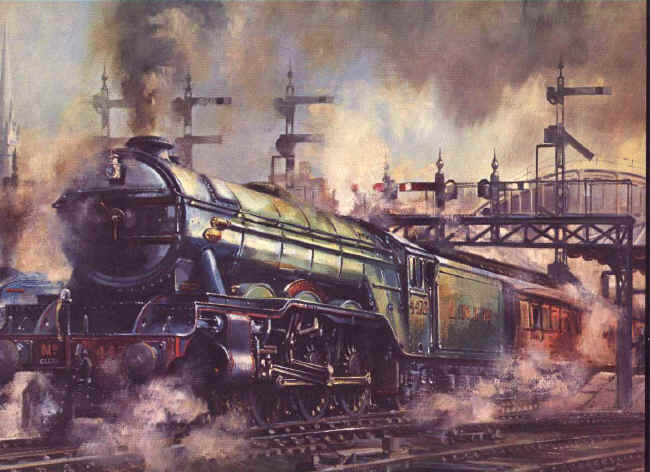
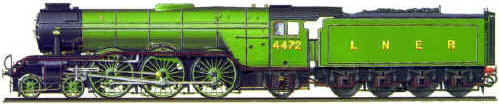
LNER 4472 the "Flying
Scotsman" at Kings Cross Station
|
|
This image of the Flying Scotsman was obtained from an old calendar forwarded to me by Robert Haywood in Kingston upon Hull. Flying Scotsman is the most famous steam locomotive in the World. Built in 1923, it has since run approximately 2.5 million miles and will celebrate its 75th birthday in 1998. The year after building, Flying Scotsman was exhibited at the British Empire Exhibition, Wembley and in 1928 hauled the first non-stop "Flying Scotsman" train from King's Cross to Edinburgh - the longest non-stop run in the World. A unique corridor tender was fitted to enable train crews to change en-route without the train stopping. In 1934, Flying Scotsman became the first locomotive to authentically achieve 100mph in the course of a test run from Leeds to King's Cross to assess the feasibility of accelerated schedules. Flying
Scotsman was rebuilt in 1947 with a high pressure boiler and in 1959 with a
Kylchap double chimney to improve the steaming capability of the boiler with
inferior quality coal. The engine was withdrawn from service by BR in 1963 after
a hard 40 year working life and was purchased by Alan Pegler who maintained the
locomotive privately for operating special trains on BR. Flying Scotsman toured
America from 1969 to 1972 and was purchased in 1973 by Sir William McAlpine who
continued to maintain the locomotive privately for hauling special trains over
BR lines and on private In 1988/89 Flying Scotsman toured Australia during the course of which a World record non-stop run for steam was achieved of 422 miles from Parkes to Broken Hill in New South Wales. In 1996 Flying Scotsman and a train of Pullman cars were purchased by Dr Tony Marchington who took on the complex and very costly responsibility of restoring the locomotive and train back to the highest standard of operational condition. The train of Pullman cars was built by Metro Cammell in 1960/61 for use on the "Tees Tyne," "Yorkshire," "Queen of Scots" and "Master Cutler" Pullman trains. They were the last Pullman cars to be built to the specification of the Pullman Car Company and the last to carry the traditional umber and cream livery. They are capable of being used with all forms of diesel and electric traction and have a maximum speed of 100mph. The name Pullman stands for "excellence" and they together with Flying Scotsman will be restored to standards worthy of this tradition.
|
|
Footnote: the foregoing description and the image of the Flying Scotsman was taken from the website [The Flying Scotsman Association]. Visit for more history, photos and general information. |
|
|
|
Southern Railways Schools Class Maunsell 4-4-0
"Cheltenham"
|
| This image of SR Locomotive "Cheltenham was also obtained from an old calendar forwarded to me by Robert Haywood. If anyone knows where the location is supposed to be, please E-mail me and let me know. |
|
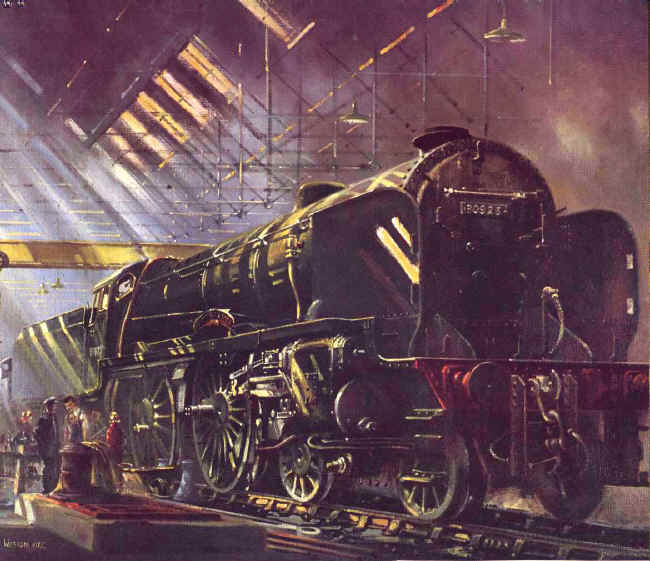
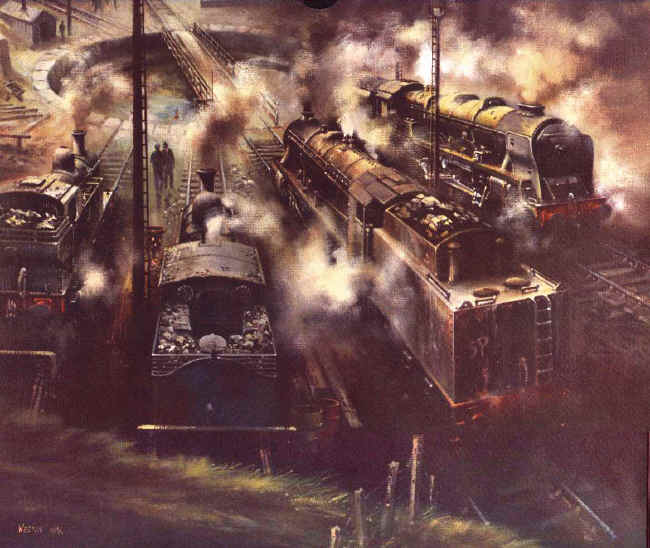
Leicester Shed
and Turntable LMS Days
|
| Another image (from an old calendar) forwarded to me by Robert Haywood. |
|
|
|
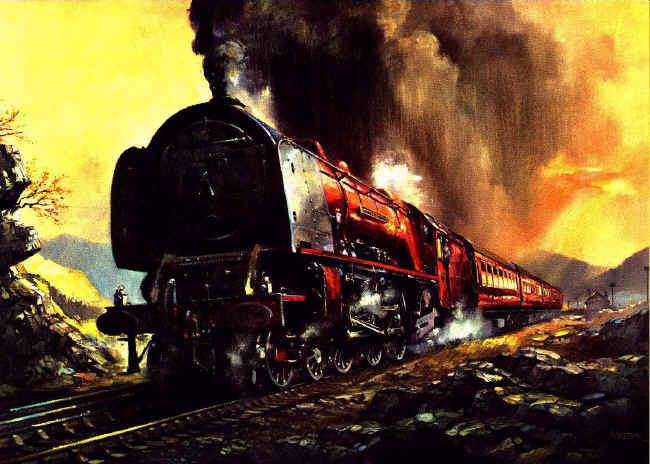
Sunset Duchess
|
| Yet another image (the old calendar again) forwarded to me by Robert Haywood. If anyone knows where the location is supposed to be, please E-mail me and let me know. |
|
|
|
[Master Cutler] [Golden Arrow] [Iron Duke] [Arrival at York] [Swindon Pride] [Great Western Splendour] [LNER 4472] [Cheltenham] [Leicester Shed] [Sunset Duchess] [B17/6 Leicester City] [Railway Posters] [Railway Postcards] |
|
|
|
|
|
Webring and Railyard visitors - please return to page 1A to exit Nostalgia Junction |
|
|
