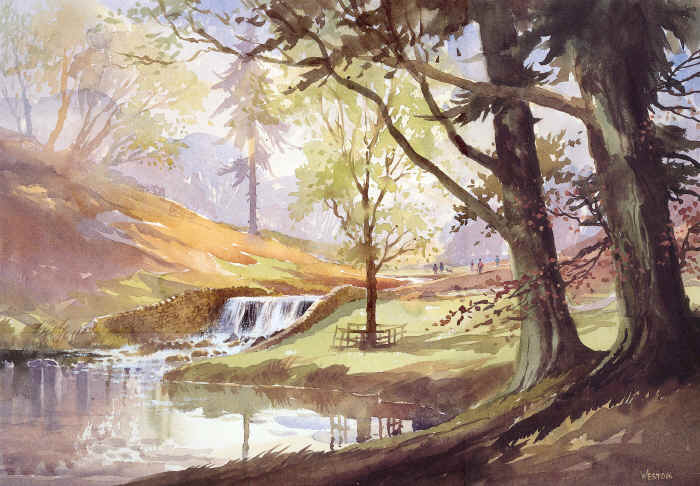
Bradgate
Notes by Mike Gould
Bradgate
Park is known to have belonged to the de Ferrers family
of Groby in the thirteenth century. Later owners
included the Greys, most notable of whom was Lady Jane
Grey [Link] who was Queen for nine days following the
death of Edward VI, and prior to being imprisoned in the
Tower of London, accused of treason and beheaded. The
folly at the top of the hill is called Old John. This is
believed to be named after an old retainer of the fifth
Earl of Stamford, who erected it in his memory after
John, the retainer, was killed accidentally here.
The
park is in the middle of Newtown Linford, a village
whose name appears to be the source of some confusion.
"A new hamlet by the ford under the lime
trees" seems somewhat less likely that the more
obvious "New town by the ford over the River
Lin". However, in both cases, all things are
relative, and "new" in this context means some
time in the thirteenth century. Famous for its herd of
fallow and red deer, the former being much more numerous
than the latter, Bradgate Park is perhaps less well
known for being the habitat of over 500 species of
beetle.
The
use of the park for deer probably arises from the poor
agricultural properties of the land. This can still be
seen in the way that the leading branches of trees like
oak have died back. In
addition to the deer, you might look out for moles,
common shrews, pigmy shrews, bats, voles, mice, foxes,
stoats, weasels and badgers, all of which have been
spotted in the park.
In
the past, the park was also grazed by horses, sheep,
cattle and rabbits. Rabbits were introduced into this
country by the Normans as a source of food. In common
with many other places, Charnwood Forest became over-run
with them at the end of the 18th Century. Rabbit
shooting became a fashionable sport, so much so that on
one night in the 19th century, around 250 rabbits were
trapped in Bradgate Park.
Efforts
are continually made to reduce the amount of bracken in
the park. The diversity of flora in olden times will
perhaps one day be restored. A
popular site for birders, the park has been visited by
over 80 species of bird, some just passing by on their
way to Cropston Reservoir.
|